Module 2: Creating Safety and Connection
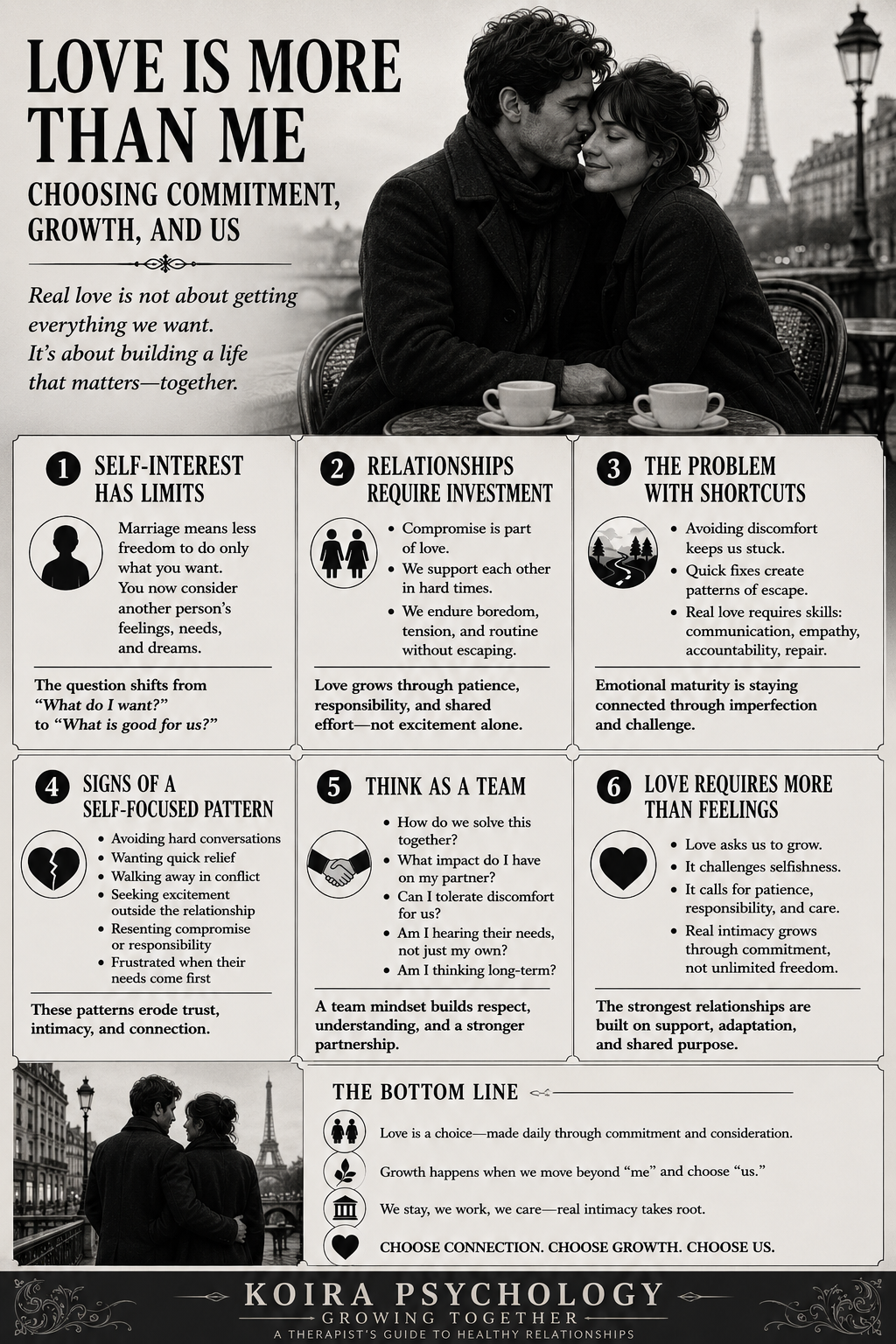
One of the greatest challenges facing many modern relationships is the belief that life should primarily revolve around personal happiness, freedom, excitement, and self-fulfilment. From a couples therapy perspective, this way of approaching life can make long-term relationships extremely difficult, because healthy marriages require something that often conflicts with these values: cooperation, sacrifice, patience, responsibility, and concern for another person’s wellbeing alongside your own.
Many people are raised in environments that strongly encourage the pursuit of pleasure and personal satisfaction above almost everything else. The message can become: avoid discomfort, seek excitement, keep your options open, do what feels good, and prioritise your own needs first. While there is nothing inherently wrong with wanting some happiness or freedom, difficulties arise when a person enters a committed relationship without developing the ability to tolerate frustration, compromise, commitment, or shared responsibility.
Marriage inevitably places limits on pure individual freedom. Another person’s feelings, needs, vulnerabilities, preferences, and dreams must now be considered. Decisions are no longer based entirely on “What do I want right now?” but also on “What is good for us?” This shift can feel deeply uncomfortable for us when we have been told and educated to see relationships primarily through the lens of personal gratification.
Relationships Cannot Function Through Self-Interest Alone
A marriage cannot survive if both partners are focused only on extracting what they want from the relationship while avoiding inconvenience, discomfort, or responsibility. Healthy relationships require mutual investment. At times, one partner may need emotional support when the other feels exhausted. Sometimes compromises must be made around finances, parenting, intimacy, social life, or future plans. At other times, couples must endure boredom, routine, disappointment, or emotional tension together without immediately escaping into distraction, self-soothing, or withdrawal.
People who are constantly searching for excitement or novelty can struggle with the ordinary realities of long-term relationships. Everyday partnership often involves some repetitive tasks, emotional labour, patience, and gradual growth rather than constant stimulation. If someone has learned to associate happiness only with intensity, pleasure, or freedom from obligation, they may begin viewing normal relationship challenges as evidence that something is wrong.
In therapy, this can sometimes appear as:
● Constantly avoiding difficult conversations
● Wanting immediate relief from emotional discomfort
● Leaving emotionally when conflict arises
● Seeking validation or excitement outside the relationship
● Resenting compromise or responsibility
● Becoming frustrated when a partner’s needs interfere with personal desires
The Problem with Shortcuts
Another difficulty arises when people become accustomed to taking shortcuts around emotional growth. Healthy relationships require learning skills such as communication, empathy, emotional tolerance, accountability, and repair after conflict. These capacities take time and effort to develop.
However, modern culture often encourages quick solutions to discomfort. Rather than working through frustration, many of us will distract ourselves, avoid vulnerability, seek external validation, or leave situations prematurely. In relationships, this can create a pattern where we repeatedly escape discomfort rather than learning how to work through it collaboratively.
Emotional maturity involves developing the ability to remain connected even when things feel imperfect, frustrating, or emotionally demanding. Love is not simply the pursuit of pleasurable feelings; it is also the willingness to stay engaged during difficulty and continue considering another person’s wellbeing.
Learning to Think as a Team
One of the most important shifts in healthy relationships occurs when people move from an individual mindset toward a cooperative mindset. This does not mean losing individuality or ignoring personal needs. Rather, it means recognising that partnership requires balancing personal desires with shared goals and mutual care.
Strong couples often learn to ask:
● How do we solve this together?
● What impact does my behaviour have on my partner?
● Can I tolerate some discomfort for the sake of the relationship?
● Am I listening only to my own needs, or also trying to understand theirs?
● Am I reacting impulsively, or considering the long-term health of the relationship?
This ability to think relationally often determines whether couples grow stronger together or become trapped in cycles of selfishness, resentment, and emotional disconnection.
Love Requires More Than Feelings
Long-term relationships ask something difficult of us: they ask us to grow beyond pure self-interest. They challenge us to become more patient, more responsible, more emotionally aware, and more capable of cooperation. This does not happen perfectly, and all couples struggle with selfishness at times. Yet healthy relationships depend on two people being willing to work against the natural human tendency to focus only on themselves.
Some of the strongest and most fulfilling relationships are not those where both people endlessly pursue individual pleasure, but where two people gradually learn how to support, adapt to, and care for one another through life’s inevitable frustrations and challenges. Real intimacy often grows not through unlimited freedom, but through learning how to lovingly live alongside another imperfect human being while building something meaningful together.

Key Points
Healthy relationships require balancing personal needs with shared responsibility.
Long-term partnerships thrive when both people consider not only what is good for themselves, but also what is good for the relationship.A self-focused approach can undermine intimacy.
When personal happiness, freedom, or immediate gratification become the highest priorities, compromise, commitment, and mutual care can become difficult.Strong relationships require tolerating discomfort and frustration.
Conflict, routine, sacrifice, and unmet desires are normal parts of committed relationships and often provide opportunities for growth rather than signs of failure.Avoiding discomfort can prevent emotional maturity.
Habits such as withdrawing, seeking constant novelty, avoiding difficult conversations, or escaping emotional tension can weaken connection over time.Successful couples learn to think as a team.
Relationship strength grows when partners adopt a cooperative mindset, asking how they can solve problems together and support each other's wellbeing.
Self-Reflection Questions
When making important decisions, do I primarily think about what I want, or do I also consider what is best for our relationship?
How do I typically respond when a relationship requires sacrifice, compromise, or patience?
Are there times when I avoid discomfort or difficult conversations instead of working through them with my partner?
How often do I approach challenges with a “me versus you” mindset compared to an “us versus the problem” mindset?
-
Add a short summary or a list of helpful resources here.