Module 1: Understanding Relationships
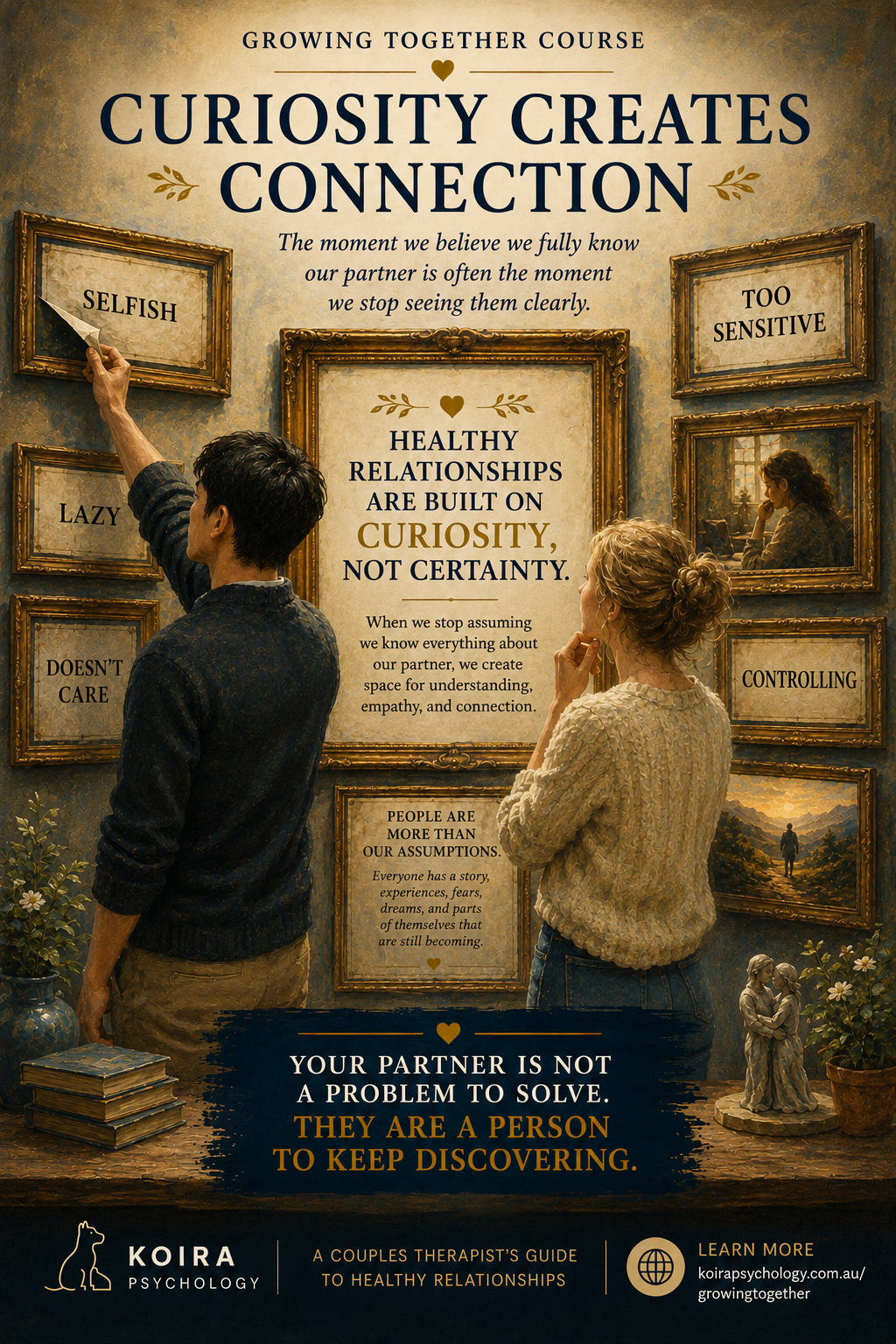
One of the uncomfortable truths about relationships is that we never completely know our partner, just as they will never completely know us. Every person has private thoughts, past experiences, fears, hopes, contradictions, and inner struggles that can never be fully seen by another person. Even in the closest relationships, there will always be aspects of another person that remain partly hidden, evolving, or difficult to explain.
From a Couples Therapy perspective, this is not a problem to solve. Healthy relationships are not built on complete certainty or perfect understanding. They are built on curiosity, openness, empathy, and the willingness to keep learning about each other over time.
Many relationship difficulties begin when couples unconsciously move away from curiosity and toward certainty. We may start believing we already know exactly why our partner behaves the way they do. We assume we understand their motives, intentions, or feelings without checking whether our assumptions are accurate. Over time, this certainty can harden into criticism, resentment, disappointment, or emotional distance.
When a partner comes home quiet after work, and instead of remaining curious, the other might immediately assume, “They are angry with me,” or “They do not care anymore.” Another partner forgets something important and is quickly labelled selfish or uncaring. Often these interpretations say more about our own fears, insecurities, and past experiences as they do about the other person.
How can couples therapy increase partners’ mutual curiosity?
In therapy we see the many ways people avoid emotional truth and replace it with subjective certainty, defensiveness, labels, or self-protective stories. In relationships, people often create simplified narratives about their partner because uncertainty can feel uncomfortable or anxiety provoking. If we can convince ourselves that we fully understand the other person, we momentarily reduce the anxiety of not knowing. Yet this certainty can distance us from both reality and genuine emotional contact.
This perspective highlights something important in Couples Therapy: many conflicts are not simply about behaviour itself, but about the meanings couples attach to behaviour. One partner may interpret emotional withdrawal as rejection, while the other experiences it as being overwhelmed or shameful. One person may experience criticism as control, while the other experiences it as an attempt to feel heard. Without curiosity, couples can become trapped reacting to assumptions rather than responding to the reality of the person in front of them.
This does not mean partners should ignore harmful behaviour or avoid important conversations. Healthy relationships require honesty, accountability, boundaries, and collaborative communication. However, it does mean recognising that another person’s inner world is always more complex than our immediate interpretations of them.
Seeing people as living, changing people
There is also something deeply human and humbling about accepting that our partner is not a fixed object for us to fully define. People continue changing across a lifetime. Their fears evolve, their identities shift, and new experiences shape them in ways neither partner can fully predict. Relationships often suffer when couples stop seeing each other as living, changing people and instead relate to an old image or fixed story about who the other person is.
In therapy, couples are often encouraged to slow down their assumptions and become more emotionally curious. Instead of saying, “You do not care about me,” a partner may learn to say, “When this happened, I felt hurt and began wondering if I mattered to you.” Instead of assuming hostile intent, couples can begin asking questions, exploring emotions, and trying to understand the deeper fears or vulnerabilities underneath conflict.
This kind of openness can feel uncomfortable because it requires tolerating uncertainty. It asks us to give up the illusion of complete knowledge and control. Yet it is often this very openness that allows emotional intimacy to deepen. When couples remain curious about each other, they create space for surprise, growth, compassion, and genuine understanding.
Love does not require complete knowledge of another person. In many ways, love involves accepting that there will always be parts of each other that remain unfinished, mysterious, contradictory, and partly unknowable. Real intimacy is not built upon perfectly solving another person, but upon continuing to meet them with care, openness, and a willingness to keep discovering who they are becoming over time.
Key Points
We can never fully know another person.
Every individual has a complex inner world that remains partly hidden, evolving, and ultimately impossible to completely understand.Curiosity creates connection, while certainty often creates distance.
Relationships suffer when partners assume they already know each other's motives, intentions, or feelings instead of remaining open and inquisitive.Many conflicts arise from interpretations rather than behaviour itself.
Couples often react to the meanings they attach to their partner's actions, which may be shaped by their own fears, insecurities, and past experiences.People are continually changing throughout life.
Healthy relationships require seeing a partner as a living, evolving person rather than relating to a fixed image or old story about who they are.Intimacy grows through openness to uncertainty.
Love is not about fully solving or understanding another person, but about continually approaching them with empathy, curiosity, and a willingness to keep learning.
Self-Reflection Questions
How often do I assume I know what my partner is thinking or feeling, rather than asking and remaining curious?
Are there stories or labels I have attached to my partner that might prevent me from seeing who they are today?
When I feel hurt or frustrated, do I react to my partner's behaviour, or to the meaning I have attached to that behaviour?
What is something new I have learned about my partner recently, and how open am I to discovering more about them?
-
Add a short summary or a list of helpful resources here.