Module 1: Understanding Relationships
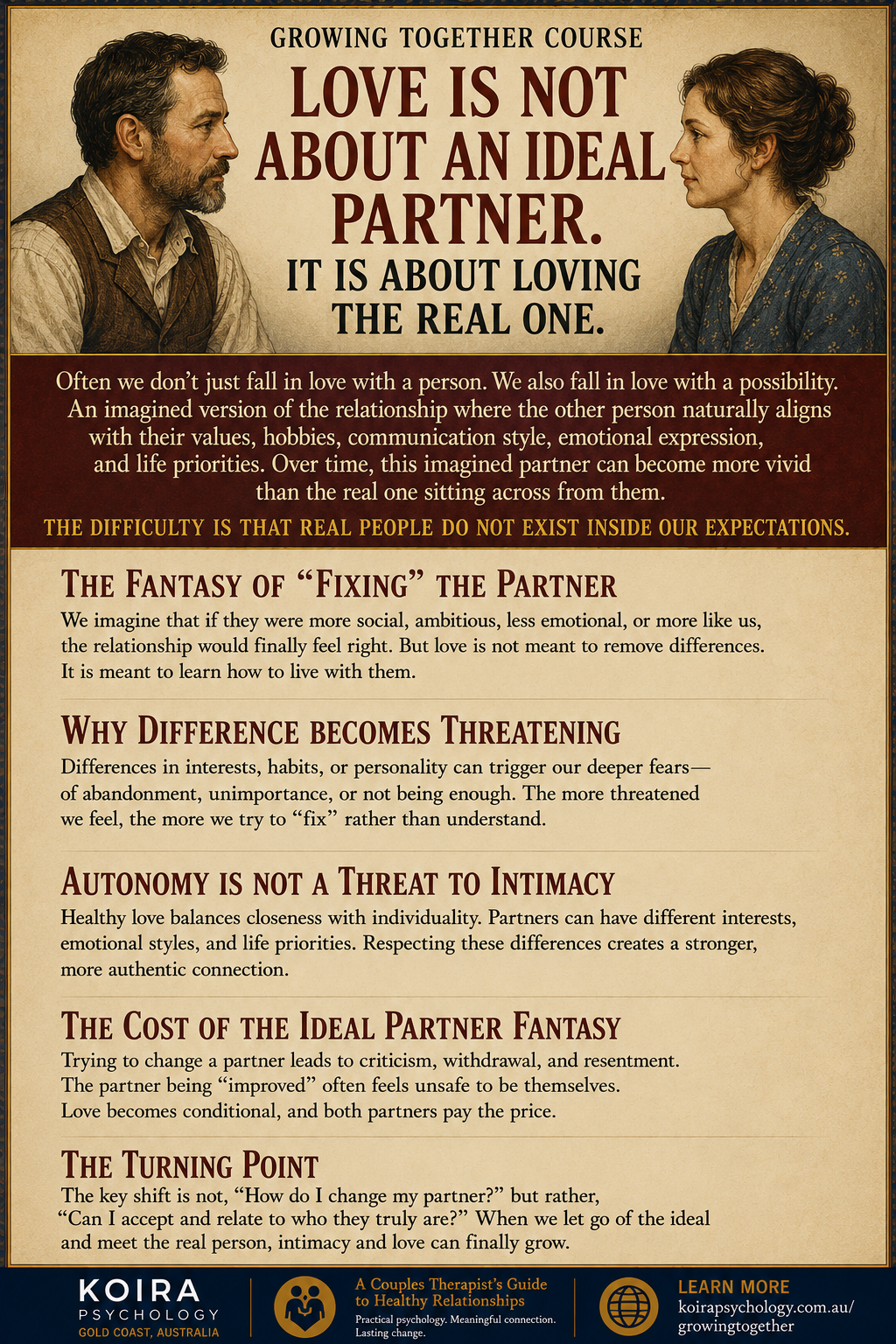
From a Couples Therapy perspective, one of the most painful and quietly persistent struggles in relationships is not conflict itself, but the gap between who our partner is and who we believe they should become.
Often we don’t just fall in love with a person. We also fall in love with a possibility. An imagined version of the relationship where the other person naturally aligns with their values, hobbies, communication style, emotional expression, and life priorities. Over time, this imagined partner can become more vivid than the real one sitting across from them.
The difficulty is that real people do not exist inside our expectations.
Therapist Jon Frederickson highlights this dynamic through a clinical example of a client who could acknowledge that her partner was a “good partner,” yet she repeatedly tried to persuade him that his interests and hobbies were “a waste of time and wrong.” What made this so painful was not a lack of love, but an inability to tolerate difference. Her partner’s separate identity was experienced not as normal or healthy, but as a problem to fix.
She eventually arrived at a stark psychological truth: she could either give up the wish for the ideal partner she wants or give up the partner she has.
This is not a punishment or a moral judgement, but it is a reality of relational life. When we cling tightly to an idealised version of our partner, we often place them in a double bind: they are loved, but only conditionally; accepted, but only if they change.
The fantasy of “fixing” the partner
In Couples Therapy, this shows up in many familiar forms:
● “If only they were more social, then we’d finally have a real relationship.”
● “If they were more ambitious, I wouldn’t feel so stuck.”
● “If they stopped being so emotional/logical/spontaneous/cautious, things would be better.”
On the surface, these sound like reasonable preferences. But underneath, they often contain a deeper fantasy: that love should remove differences rather than learn how to live with it.
Why difference becomes threatening
Difference is not the problem. The threat we attach to it is.
For some people, a partner who enjoys solitude may trigger fears of abandonment. For others, a partner who is highly social may evoke fears of being unimportant. In this way, the partner’s personality becomes a screen onto which earlier relational anxieties are projected.
The more threatened we feel, the more urgent the “fixing” becomes.
Autonomy is not a threat to intimacy
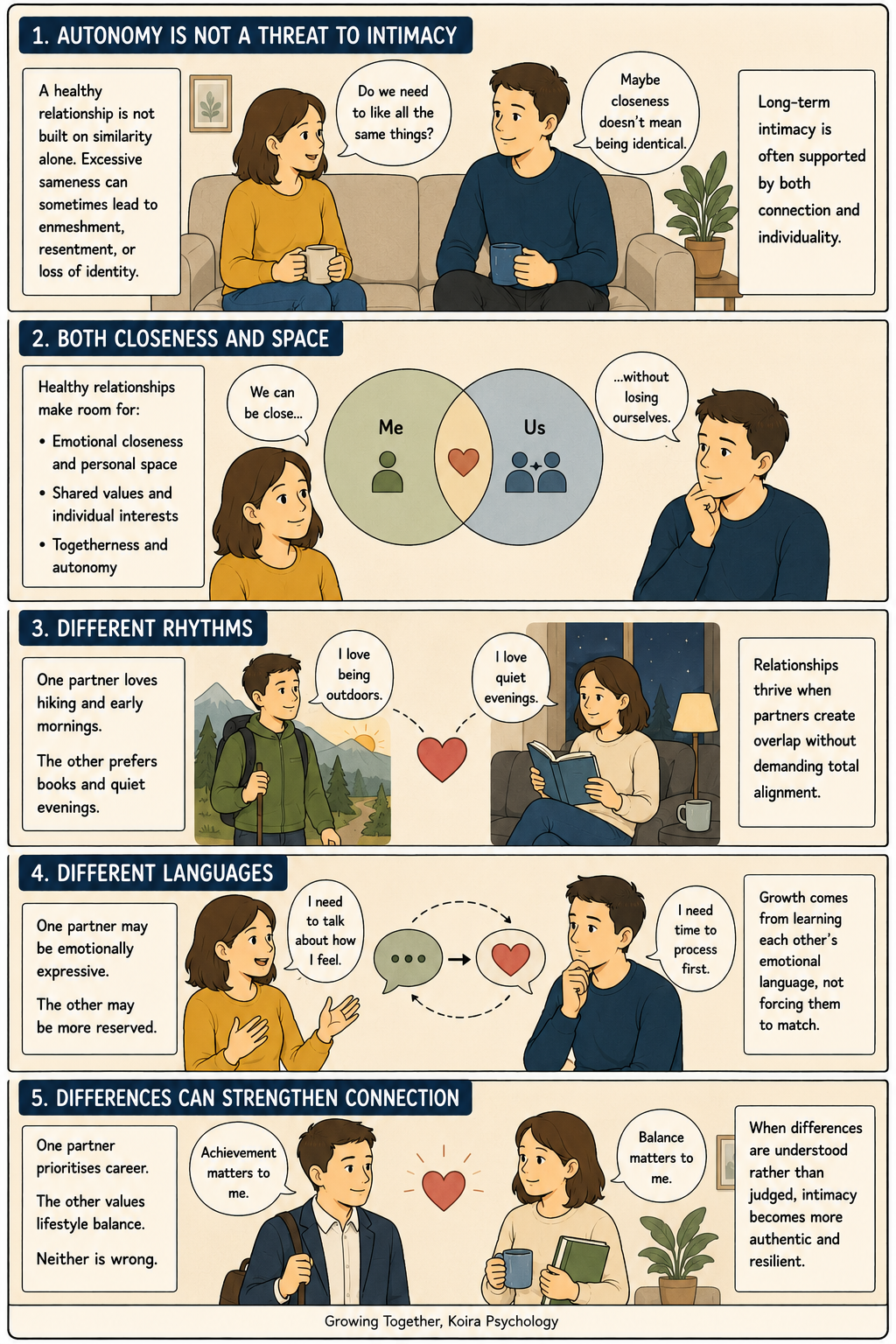
A healthy relationship is not built on similarity alone. In fact, excessive sameness can sometimes lead to enmeshment, resentment, or loss of identity. What tends to support long-term intimacy is the capacity for:
● emotional closeness and personal space
● shared values and individual interests
● togetherness and autonomy
For example:
● One partner may love hiking and early mornings, while the other prefers reading and quiet evenings. The relationship thrives not when one converts the other, but when both respect these rhythms and create overlap without demanding total alignment.
● One partner may be highly expressive emotionally, while the other is more reserved. Growth comes not from forcing emotional style to match, but from learning translation between two emotional “languages.”
● One partner may be career-focused, while the other prioritises lifestyle balance. Conflict emerges when one is judged as “wrong,” rather than understood as holding a different, legitimate value system.
The cost of the ideal partner fantasy
When the fantasy of the “ideal partner” dominates, it often leads to:
● chronic criticism disguised as “helpfulness”
● emotional withdrawal when change doesn’t happen
● cycles of resentment and defensiveness
● a growing sense of failure in both partners
Importantly, the partner being “improved” often begins to feel less and less safe to simply exist as themselves. Over time, they may either comply and lose parts of their identity, or resist and become the very “problem” they were accused of being.
The turning point in relationships
A key shift often occurs when a person begins to ask not, “How do I change my partner?” but rather:
● Can I live with who they actually are?
● What does it mean about me that I struggle with this difference?
● Am I trying to eliminate my anxiety and fears by reshaping another person?
This shift is not about resignation. It is about realism. And realism, in relationships, is often the beginning of genuine intimacy.
Because when we stop relating to an imagined partner, we finally have the chance to meet and love the real one.
Key Points
Many people fall in love with an ideal, not just a person.
Relationship difficulties often arise when we become attached to a fantasy of who our partner should be, rather than accepting who they actually are.Trying to "fix" a partner can undermine intimacy.
When love becomes conditional on change, partners can feel criticised, controlled, or accepted only if they become someone different.Differences are normal, but the meaning we attach to them creates conflict.
A partner's personality, interests, or habits often trigger deeper fears and insecurities, leading us to view normal differences as problems that need to be solved.Healthy relationships balance connection and individuality.
Strong couples learn to respect differences in interests, values, emotional styles, and personal identities rather than demanding complete similarity or agreement.Real intimacy begins when we let go of the ideal.
A major therapeutic shift occurs when people stop asking, "How can I change my partner?" and start asking, "Can I accept and relate to the person they truly are?" Accepting reality rather than pursuing fantasy creates the foundation for genuine closeness and love.
Self-Reflection Questions
Are there ways I wish my partner would be different, and how much of my relationship dissatisfaction is tied to those expectations?
What fears, insecurities, or unmet needs might sit underneath my desire to change certain aspects of my partner?
Do I experience my partner's differences as a threat, or can I view them as part of their unique identity?
Am I relating more to the person my partner actually is, or to the person I hope they will become?
-
Add a short summary or a list of helpful resources here.