Module 2: Creating Safety and Connection
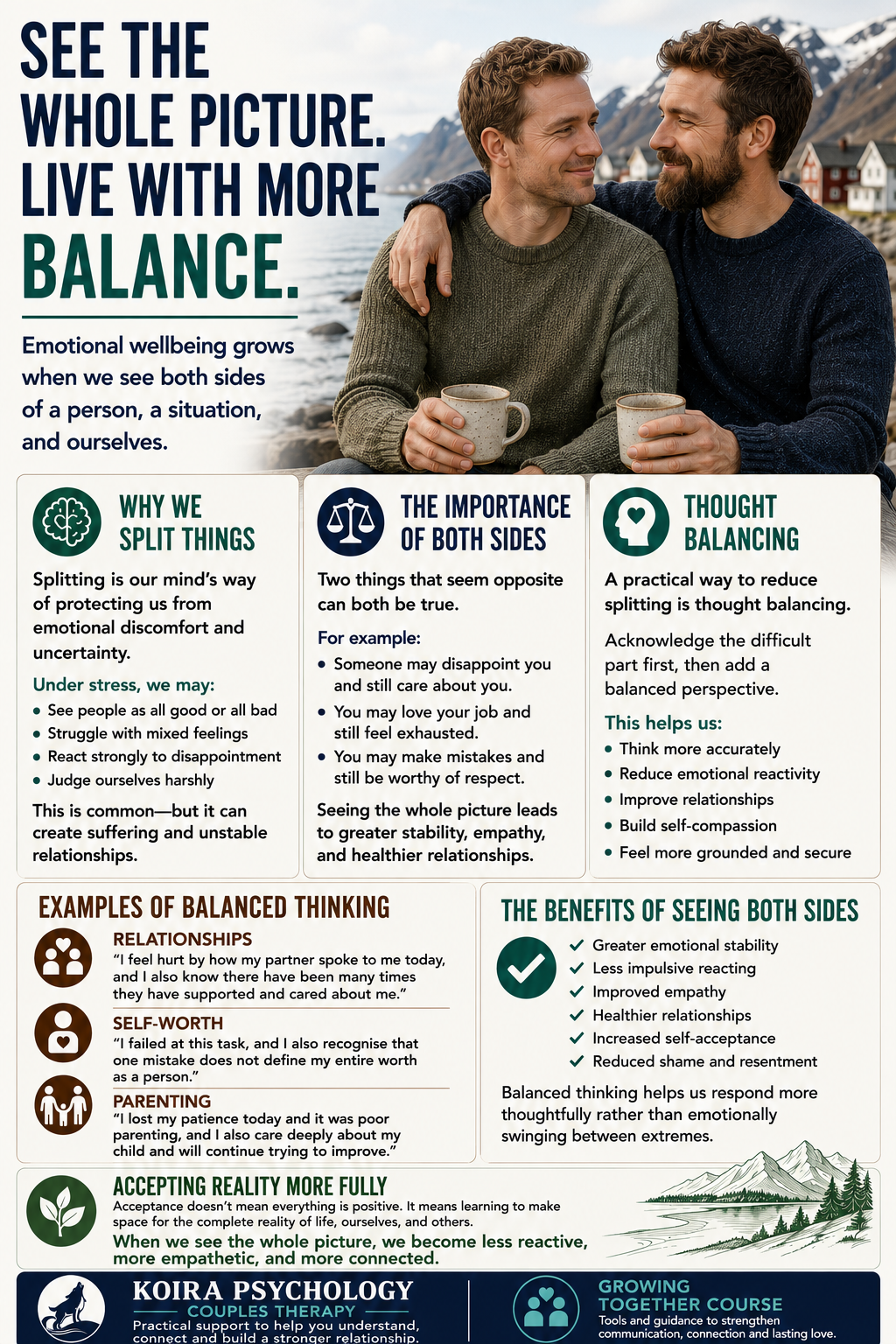
As human beings, we naturally try to simplify the world around us. When situations feel emotionally overwhelming, uncertain, or painful, the mind often responds by placing people, experiences, or even ourselves into one-dimensional categories. Someone becomes entirely good or entirely bad. A relationship becomes either perfect or hopeless. We see ourselves as either capable or a failure.
In psychology, this tendency is sometimes referred to as splitting, a way of black-and-white thinking that separates things. While this can temporarily reduce emotional confusion, it often creates greater suffering over time because life and people are rarely one-dimensional.
From a clinical psychology perspective, emotional wellbeing is often connected to our ability to see and accept the “whole picture”. Mature emotional functioning involves learning to recognise that two seemingly opposite things can both be true at the same time.
A person may disappoint you and still care deeply about you.
You may love your job and still feel exhausted by it.
You may have made mistakes and still be worthy of compassion and respect.
Learning to see the “whole picture” can reduce emotional reactivity, improve relationships, and help us respond to life with greater balance and acceptance.
Why the Mind Splits Things into Extremes
Splitting is not a sign of weakness or failure. It is usually an attempt by the mind to protect itself from emotional discomfort and conflict.
When emotions become intense, certainty can feel safer than complexity. Seeing someone as “completely wrong” may feel easier than holding the tension of recognising both their flaws and their humanity. Likewise, idealising someone as “perfect” can lead us to avoid feelings of fear relating to insecurity, disappointment, or vulnerability.
The theory is that this pattern often develops early in life. Children naturally think in more black-and-white ways because they do not yet have the emotional capacity to integrate complexity. As we mature emotionally, we gradually learn that people can be loving and imperfect, reliable and flawed, kind and sometimes hurtful.
However, under stress, many adults can still fall back into extreme thinking patterns.
This may look like:
● Quickly going from admiration to resentment in relationships
● Viewing yourself as a success one day and a failure the next
● Struggling to tolerate mixed feelings
● Feeling emotionally overwhelmed by disappointment or conflict
● Finding it difficult to forgive mistakes, either your own or someone else’s
While this style of thinking is understandable, it can make relationships unstable and intensify anxiety, anger, shame, or hopelessness.
The Importance of Seeing Both Sides
Psychological growth often involves increasing our capacity to tolerate emotional complexity. Seeing both sides of a person or situation does not mean excusing harmful behaviour or ignoring problems. Rather, it means allowing reality to be more complete and complex.
For example:
● A parent may have loved you deeply and also failed to meet some emotional needs.
● A partner may have many positive qualities while still behaving in frustrating ways.
● You may feel grateful for aspects of your life while simultaneously struggling emotionally to accept certain realities.
● You may feel confident in one area of life and insecure in another.
When we move away from “all or nothing” thinking, we often experience:
● Greater emotional stability
● Less impulsive reacting
● Improved empathy
● Healthier relationships
● Increased self-acceptance
● Reduced shame and resentment
Importantly, balanced thinking helps us respond more thoughtfully rather than emotionally swinging between extremes.
Thought Balancing: A Practical Therapeutic Technique
One helpful therapeutic approach for reducing splitting is often called thought balancing.
This involves intentionally acknowledging the negative aspect of a situation first, followed by a balanced or positive perspective second.
The order matters.
When people try to force positivity too quickly, the mind often rejects it because it feels invalidating or unrealistic. However, when the difficult reality is acknowledged first, the nervous system often becomes more open to accepting a fuller perspective.
The goal is not “positive thinking.” The goal is accurate and balanced thinking.
Example 1: Relationships
Instead of:
“My partner never cares about me.”
A balanced thought might be:
“I feel hurt by how my partner spoke to me today, and I also know there have been many times they have supported and cared about me.”
This allows both the pain and the broader reality to coexist.
Example 2: Self-Worth
Instead of:
“I failed at this, so I’m useless.”
A balanced thought could be:
“I failed at this task, and I also recognise that one mistake does not define my entire worth as a person.”
Example 3: Parenting
Instead of:
“I’m a terrible parent.”
A more balanced reflection may be:
“I lost my patience today and it was poor parenting, and I also care deeply about my child and will continue trying to improve.”
This type of thinking allows non-punishing guilt, while still allowing responsibility and growth.
Over time, practising this skill can help people:
● Tolerate uncertainty more effectively
● Reduce conflict in relationships
● Become less self-critical
● Improve emotional resilience
● Feel more grounded and emotionally secure
Importantly, acceptance often emerges not from denying painful realities, but from integrating them into a fuller understanding of life.
How Therapy Can Help
Therapy can provide a supportive space to explore the patterns underneath black-and-white thinking. Often, splitting develops for understandable emotional reasons. Some people learned early in life that emotional safety depended on staying hyper-alert to rejection, criticism, or inconsistency. Others may have experienced environments where complexity was not tolerated, leading them to suppress mixed emotions.
In therapy, a person can begin to:
● Notice automatic extreme thoughts
● Understand the emotional triggers behind them
● Learn to tolerate conflicting feelings
● Develop greater emotional regulation
● Build a more compassionate and realistic view of themselves and others
A therapist may gently help someone slow down and examine situations more fully rather than reacting from emotional intensity alone.
Over time, therapy can help people move from rigid emotional positions toward greater flexibility, acceptance, and emotional maturity.
Accepting Reality More Fully
Seeing the whole picture is not always easy. Complexity can feel uncomfortable because it asks us to let go of certainty and tolerate emotional ambiguity. Yet psychological wellbeing often grows through this very process.
When we begin to see ourselves and others more fully, we often become less reactive, more empathetic, and more capable of genuine connection.
Acceptance does not mean pretending everything is positive. It means learning to make space for the complete reality of a person, a situation, or ourselves.

Five Key Points
Black-and-white thinking can distort reality
When emotions are intense, people often fall into “all-or-nothing” thinking, seeing themselves, others, or situations as entirely good or entirely bad. While this may provide temporary certainty, it often creates greater emotional distress and relationship difficulties.Emotional maturity involves holding complexity
Psychological wellbeing grows when we can recognise that seemingly opposite truths can coexist. Someone can care about us and still disappoint us. We can make mistakes and still be worthy of compassion. Seeing the whole picture leads to greater balance and acceptance.Extreme thinking can damage relationships and self-esteem
Splitting often contributes to relationship conflict, self-criticism, shame, resentment, and emotional instability. It can cause people to swing between idealising and condemning others, or between feeling highly competent and completely inadequate.Thought balancing helps create a more realistic perspective
A practical therapeutic technique is to acknowledge the difficult reality first and then add a broader, balanced perspective. This is not about forced positivity but about seeing the situation more accurately and completely, reducing emotional reactivity and promoting resilience.Therapy can help develop greater emotional flexibility
Therapy helps people identify automatic extreme thoughts, understand the emotions driving them, tolerate mixed feelings, and build a more compassionate and realistic view of themselves and others. Over time, this supports healthier relationships, improved emotional regulation, and greater self-acceptance.
Self-Reflection Questions
When I feel hurt, disappointed, or criticised, do I tend to view myself, my partner, or the situation in all-or-nothing terms?
What person or situation in my life would benefit from me seeing a more complete picture rather than focusing only on the positive or negative aspects?
How comfortable am I with holding mixed feelings, such as loving someone while also feeling frustrated, hurt, or disappointed by them?
What balanced thought could I practise when I notice myself falling into extreme self-criticism, resentment, or idealisation?
-
Add a short summary or a list of helpful resources here.