Module 3: Communicating Effectively
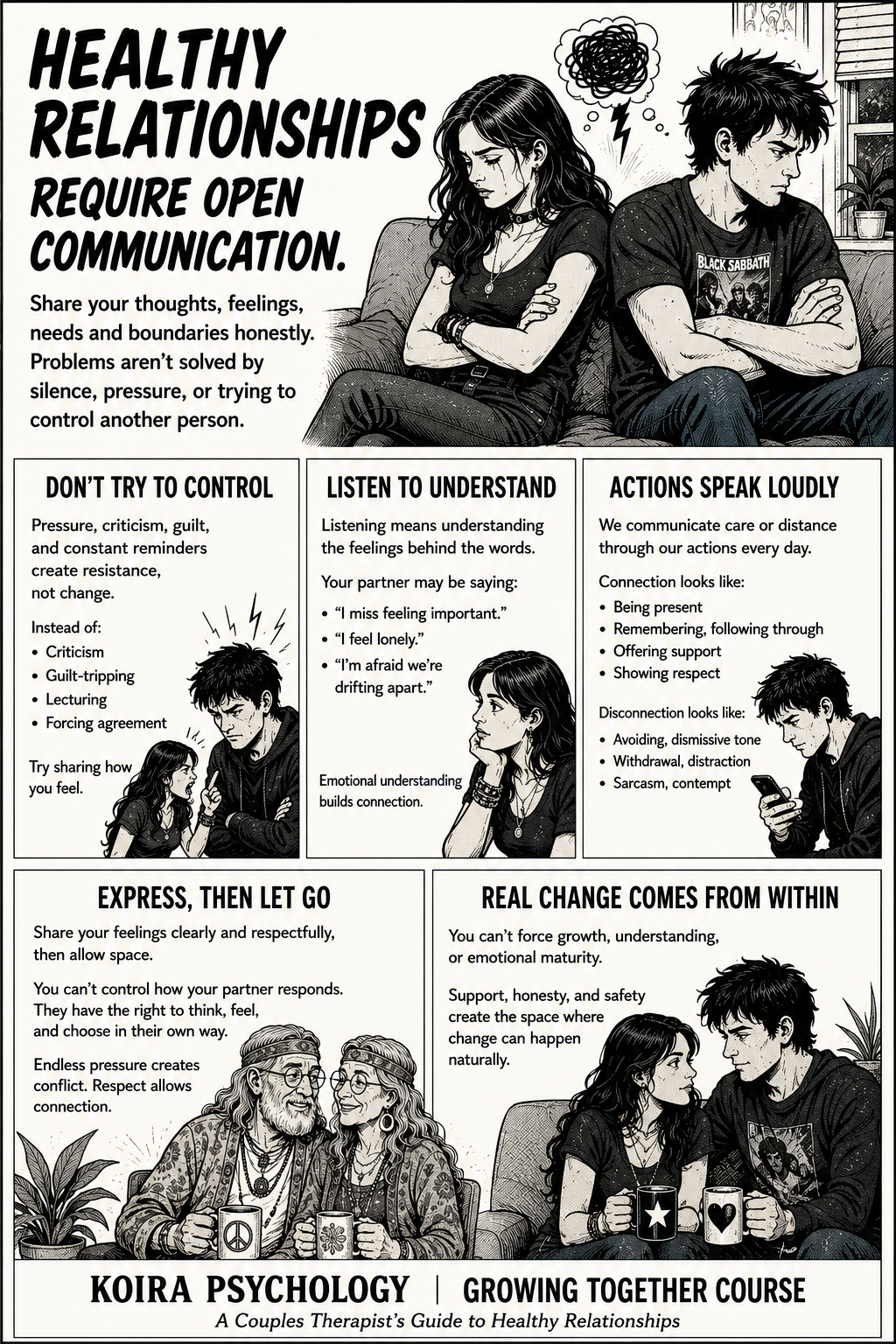
One of the healthiest but often most difficult lessons in relationships is learning to respect your partner’s autonomy; their right to think differently, feel differently, make their own choices, and grow in their own time. From a couples therapy perspective, many relationship conflicts arise not simply because couples disagree, but because one or both partners struggle to tolerate the other person being separate from them.
Healthy relationships require open communication. It is important to express your thoughts, feelings, concerns, needs, and boundaries honestly. Problems are rarely solved by silence, emotional suppression, or pretending everything is fine. However, there is an important difference between expressing yourself and attempting to control, pressure, nag, or emotionally force another person into changing.
Many people unconsciously believe that if they just explain themselves enough, argue strongly enough, criticise enough, or repeat themselves often enough, their partner will eventually become the person they want them to be. Yet lasting change rarely happens because another person pressures us into it. Most meaningful change comes from within, from insight, personal responsibility, readiness, and internal motivation.
The Difference Between Controlling and Sharing
Difficulties arise when communication shifts from sharing feelings into trying to manage or control another person’s internal world using these losing strategies:
● Repeated criticism
● Constant reminders
● Lecturing
● Guilt-tripping
● Emotional pressure
● Attempts to force agreement
● Trying to wear the other person down
Partners who use losing strategy to control their partners may make these statements:
● “I cannot believe you are off playing golf again”
● “How could you not see you are needed at home?”
● “I’m sure you don’t want the kids to be disappointed”
● “What would your mother say about this?”
● “You don’t know what’s good for you”
● “Time and time again you have let me down”
Ironically, the more pressured people feel, the more resistant they often become. Human beings generally do not respond well to feeling controlled, even when the intentions behind the pressure are understandable.
For example, one partner may desperately want the other to become more emotionally expressive. They may repeatedly push for deeper conversations, demand reassurance, or criticise emotional withdrawal. Yet the more pressure the withdrawn partner feels, the more anxious or defensive they may become, leading them to retreat even further.
In another relationship, one partner may strongly believe the other should change their hobbies, habits, friendships, or lifestyle. They repeatedly explain why the partner is “wrong” or needs to improve. Over time, the relationship can begin to feel less like a partnership and more like a constant attempt at correction or management.
In therapy, couples are often encouraged to state their experience clearly and share respectfully:
● “I feel lonely when we do not spend time together.”
● “I would appreciate more help around the house on the weekend.”
● “I feel hurt when we stop communicating after conflict.”
This is healthy emotional honesty.
Allowing Another Person to Be Separate
Respecting autonomy means recognising that your partner is not an extension of yourself. They are a separate human being with their own personality, history, fears, values, preferences, and pace of growth. This does not mean accepting harmful behaviour without boundaries. It also does not mean never influencing each other. Healthy relationships naturally involve mutual influence and growth.
However, healthy influence (encouragement) is different from coercion.
You can honestly express your needs and feelings while still accepting that your partner has the freedom to respond in their own way. This requires tolerating uncertainty and emotional discomfort. Sometimes your partner may not change as quickly as you want. Sometimes they may never fully become the version of them you imagine they should be.
Couples therapy often involves helping people accept this reality while also learning how to relate to the real person in front of them rather than continually fighting an internal fantasy of who they believe the other person must become.
“Say Your Piece, Then Shut Up”
There is an old story about an older married couple who were asked how they had managed to avoid significant disharmony throughout their long marriage. Their answer was simple: “We both say our piece, then shut up.”
Beneath the humour is an important relational truth.
Eventually couples can start to recognise the difference between expressing themselves and endlessly trying to force agreement. They can communicate honestly, but they also allow space. They do not continually hammer away at each other in the hope of controlling the other person’s mind. They recognise that after expressing their thoughts clearly and respectfully, the other person has the right to reflect, disagree, change slowly, or make their own decisions.
Many times we unknowingly escalate conflict because neither person can tolerate letting go after speaking. Conversations become repetitive cycles where both partners attempt to overpower the other through persistence, intensity, or emotional pressure. Over time, this creates exhaustion, defensiveness, and emotional distance.
Real Change Cannot Be Forced
One of the hardest realities in relationships is that you cannot make another person emotionally grow before they are ready. You cannot force empathy, maturity, insight, vulnerability, or motivation through pressure alone. External pressure may create temporary compliance, but genuine and lasting change usually emerges when a person internally recognises the need for change themselves.
This is why couples therapy often focuses less on controlling the partner and more on helping individuals:
● communicate clearly,
● understand their own emotional patterns,
● set healthy boundaries,
● tolerate differences,
● and develop greater acceptance of uncertainty and separateness.
Paradoxically, relationships often become calmer and more connected when partners stop trying to force each other into change. When people feel emotionally safe rather than controlled, they are often more open to reflection, growth, and genuine change.
Balancing Honesty and Acceptance
Healthy relationships require both honesty and acceptance. You should be able to say what you think and feel openly. Suppressing needs or pretending not to care often leads to resentment. Yet healthy love also involves recognising the limits of your control over another person.
One of the deepest signs of emotional maturity is the ability to say:
“This is how I feel. This is what matters to me. And I also recognise that you are a separate person with your own mind, choices, and journey.”
Relationships become far more peaceful when couples stop trying to force change through pressure and instead learn how to communicate honestly while respecting each other’s autonomy, individuality, and freedom to grow in their own time.

Key Points
Healthy relationships require respect for each partner's autonomy.
Loving someone does not mean controlling their thoughts, feelings, decisions, or pace of growth. Healthy intimacy allows for individuality and separateness.There is a difference between expressing yourself and trying to control your partner.
Honest communication involves sharing feelings, needs, and concerns, while controlling behaviour attempts to pressure, guilt, criticise, or force change.Pressure often creates resistance rather than growth.
The more people feel managed, criticised, or coerced, the more defensive, withdrawn, or resistant they often become.Meaningful change usually comes from internal motivation.
Lasting growth is rarely achieved through external pressure. People are more likely to change when they feel emotionally safe and personally ready to do so.Strong relationships balance honesty with acceptance.
Emotional maturity involves expressing what matters to you while accepting that your partner is a separate person who has the right to make their own choices.
Self-Reflection Questions
When I want my partner to change, do I tend to express my feelings clearly, or do I resort to pressure, criticism, or repeated attempts to convince them?
How comfortable am I with my partner having different opinions, interests, priorities, or ways of doing things than I do?
Are there areas where I am trying to change my partner rather than learning to understand, accept, or set healthy boundaries around the issue?
After I have honestly expressed my thoughts and feelings, am I able to give my partner space to reflect and respond in their own way?
-
Add a short summary or a list of helpful resources here.