Module 1: Understanding Relationships
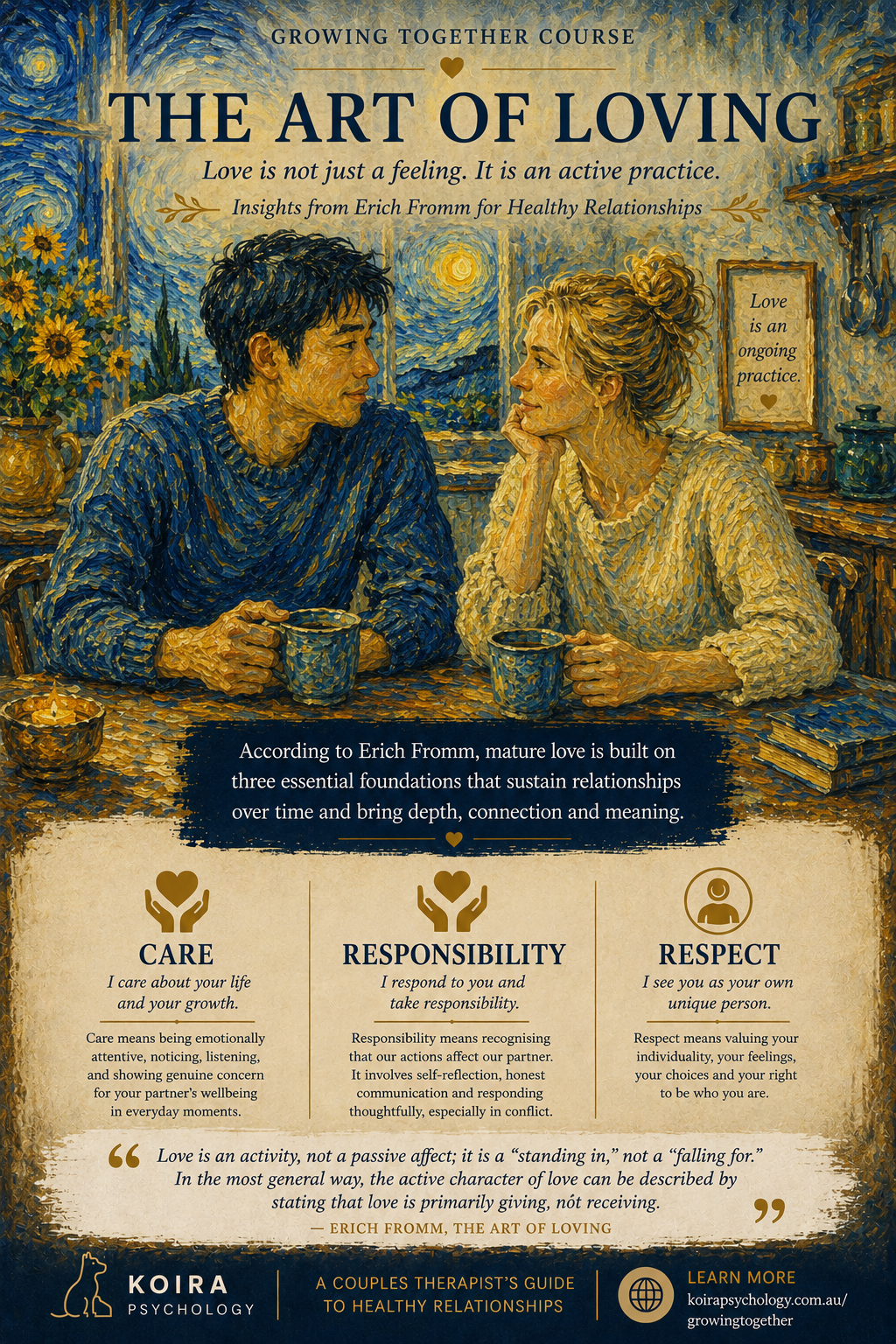
“Love isn't something natural. Rather it requires discipline, concentration, patience, faith, and the overcoming of narcissism. It isn't a feeling, it is a practice.”
Erich Fromm, The Art of Loving
Psychoanalyst and philosopher Erich Fromm, in his influential book The Art of Loving, argued that love is not simply a feeling that happens to us, but an active practice that requires maturity, effort, awareness, and discipline. From a Couples Therapy perspective, many relationship difficulties arise because people often approach love as something they should passively receive rather than something they actively participate in creating.
Fromm described several important foundations of mature love, but three central premises stand out strongly in long-term relationships: care, responsibility, and respect. These qualities often determine whether a relationship deepens over time or becomes dominated by resentment, selfishness, and emotional disconnection.
Love as Care
Fromm believed that genuine love involves active care for another person’s life and growth. Care means moving beyond self-absorption and developing a sincere concern for another person’s wellbeing.
In relationships, care is often expressed in ordinary daily moments rather than dramatic gestures. It may involve listening attentively after a difficult day, noticing when a partner seems overwhelmed, making practical efforts to support each other, or showing interest in the other person’s emotional world.
For example, one partner notices the other has become unusually quiet and withdrawn during the week. Instead of ignoring it or becoming defensive, they gently ask, “You seem stressed lately. How are you doing?” This small moment reflects emotional attentiveness and care.
By contrast, relationships often suffer when partners become overly focused on their own frustrations, needs, or disappointments while losing curiosity about the other person’s experience. Couples can begin coexisting practically while emotionally neglecting one another.
From a therapeutic perspective, many people long less for perfection from their partner and more for the feeling that their inner world matters to someone.
Love as Responsibility
Fromm did not use responsibility in the sense of control or obligation, but as a willingness to emotionally respond to another person’s needs and humanity. Mature love involves recognising that our actions affect the people we love.
This becomes especially important during conflict.
For example, during an argument, one partner may feel the urge to storm out, shut down, or say something cruel in order to relieve their own frustration. Responsibility involves recognising the emotional impact of those reactions and attempting to respond more thoughtfully as a reminder to yourself that your goal in responding is rooted in loving your partner.
Another everyday example may involve a partner repeatedly forgetting important commitments or emotional conversations. A responsible approach would involve acknowledging the hurt caused, reflecting honestly on their behaviour, and making efforts toward reliability rather than dismissing the issue defensively.
In couples therapy, responsibility often means helping partners move away from blame and toward self-reflection:
● “How am I contributing to this pattern?”
● “Have I explored the issue with my partner openly?”
● “What effect does my reactive behaviour have on my partner?”
● “Am I responding thoughtfully, or simply reacting punitively?”
Without responsibility, relationships can become emotionally unsafe because one or both partners continually prioritise immediate emotional relief over the long-term health of the relationship.
Love as Respect
Perhaps one of Fromm’s most profound ideas is that real love requires respect. Respect means recognising the other person as a separate individual rather than trying to possess, control, reshape, or dominate them.
Many couples unconsciously confuse love with control. They may believe that if their partner truly loved them, they would think the same way, behave accordingly, meet all emotional needs perfectly, or become the version of them they imagine they should be.
Respect involves tolerating separateness.
For example, one partner may enjoy hobbies, friendships, or ways of relaxing that the other does not fully understand. An immature approach might involve criticism, pressure, or repeated attempts to change the person. A respectful approach recognises that healthy relationships allow room for individuality and autonomy.
Another common example occurs during disagreements. Respect does not require complete agreement, but it does require allowing the other person to have their own thoughts, feelings, and perspectives without humiliation, contempt, or coercion.
In therapy, many couples struggle because conversations stop being attempts to understand each other and instead become attempts to overpower or correct one another. Respect allows couples to communicate honestly while still recognising the other person’s dignity and individuality.
Love Is an Ongoing Practice
One of Fromm’s most important contributions is his reminder that love is not sustained by feelings alone. Feelings naturally fluctuate over time. Long-term relationships inevitably include stress, routine, disappointment, conflict, and emotional vulnerability.
What sustains relationships is often the ongoing practice of care, responsibility, and respect in everyday interactions.
This may look like:
● Choosing to listen instead of immediately defending yourself
● Acknowledging hurt instead of dismissing it
● Supporting your partner during difficult periods
● Respecting differences instead of trying to erase them
● Taking responsibility for your own behaviour
● Continuing to show interest in your partner’s inner world over time
From a couples therapist’s perspective, many relationship problems emerge when love becomes passive, and couples wait and expect to “feel lovingness” before acting with care, responsibility, and respect. Yet mature love often works in the opposite direction. Loving actions themselves help rebuild connection, trust, and intimacy.
Erich Fromm viewed love not as something we fall into effortlessly, but as an art that requires patience, humility, self-awareness, and continual practice. In everyday relationships, these qualities are rarely expressed through grand romantic moments alone, but through the countless small ways couples choose to care for, respond to, and respect one another each day.
“Love is an activity, not a passive affect; it is a “standing in,” not a “falling for.” In the most general way, the active character of love can be described by stating that love is primarily giving, not receiving.”
Erich Fromm, The Art of Loving
Key Points
Love is a practice, not simply a feeling.
Fromm argued that lasting love is created through intentional actions and habits rather than relying on emotions alone.Care involves actively attending to a partner's wellbeing.
Healthy relationships are strengthened when partners remain interested in each other's emotional world and respond with attentiveness and support.Responsibility means recognising the impact of our behaviour.
Mature love requires self-reflection, accountability, and a willingness to respond thoughtfully rather than react impulsively.Respect requires honouring a partner's individuality.
Loving someone does not mean controlling, changing, or possessing them; it means allowing them to remain a separate person with their own thoughts, feelings, and interests.Strong relationships are built through everyday acts of love.
Connection, trust, and intimacy are sustained through repeated expressions of care, responsibility, and respect in daily life, especially during difficult times.
Self-Reflection Questions
In what ways do I actively show care for my partner's emotional wellbeing and personal growth?
When relationship difficulties arise, how willing am I to reflect on my own contribution to the problem?
How well do I respect my partner's individuality, especially when their preferences, opinions, or choices differ from my own?
What small daily actions help us practice care, responsibility, and respect in our relationship?
-
The Art of Loving by Erich Fromm is available as a e-book at Gold Coast Library