Module 1: Understanding Relationships
Why Couples Keep Having the Same Arguments
As a couples therapist, I often see partners become frustrated because they cannot understand why the same conflicts keep repeating. They may learn communication skills, practice active listening, and genuinely want a better relationship, yet somehow find themselves arguing, falling into familiar patterns of criticism, defensiveness, withdrawal, or resentment.
One useful framework for understanding these recurring interactions comes from Transactional Analysis (TA), developed by psychiatrist Eric Berne. Within TA, a particularly powerful concept is that of the four life positions—deeply held beliefs about ourselves and other people that influence how we think, feel, and interact.
These life positions often operate outside our awareness, shaping the tone of our relationships and influencing how we interpret our partner's behaviour.
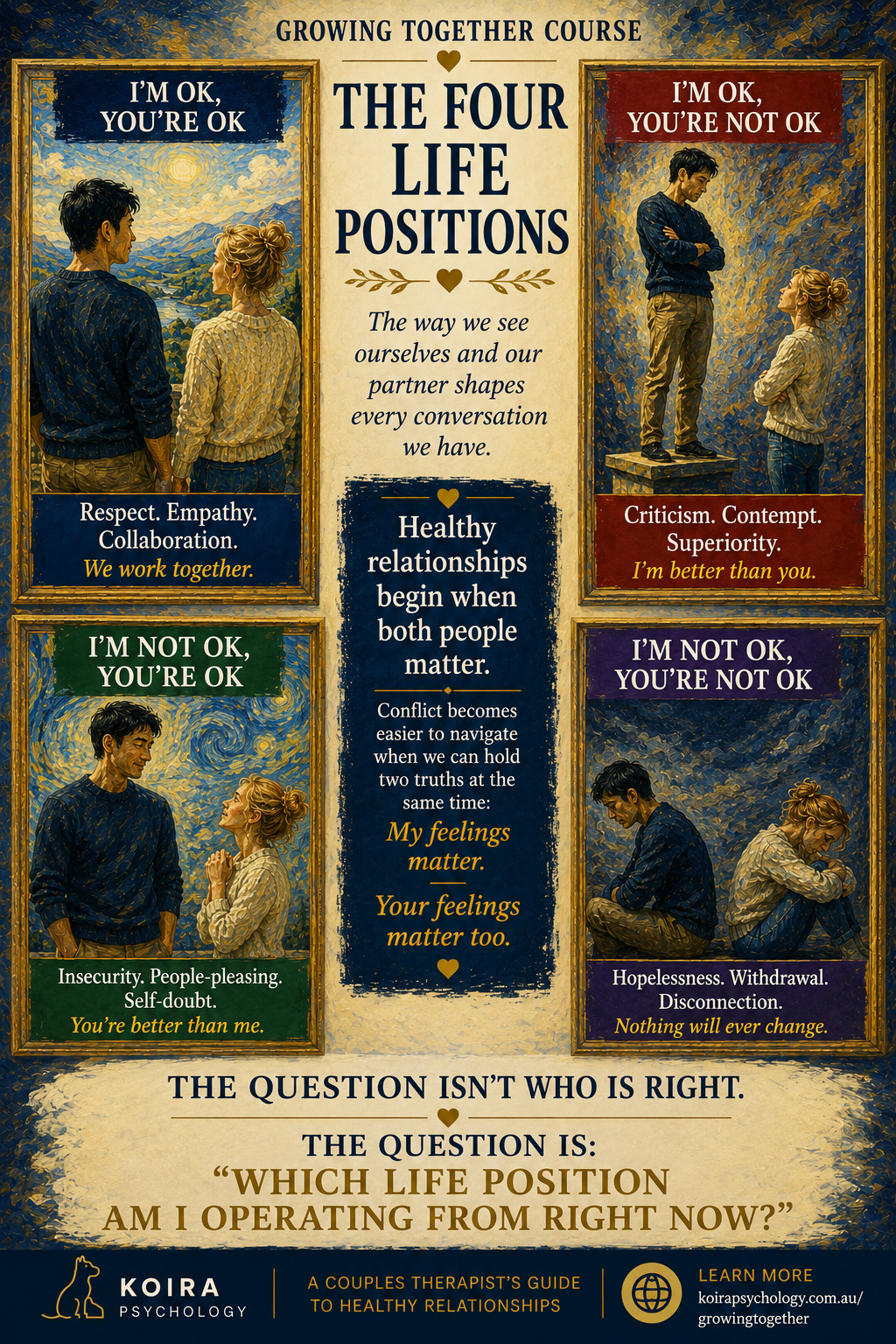
The Four Life Positions
The four life positions are:
I'm OK, You're OK
I'm OK, You're Not OK
I'm Not OK, You're OK
I'm Not OK, You're Not OK
These positions are not fixed personality traits. Most people move between them depending on circumstances, stress levels, and relationship dynamics. However, many individuals tend to favour one position more than others.
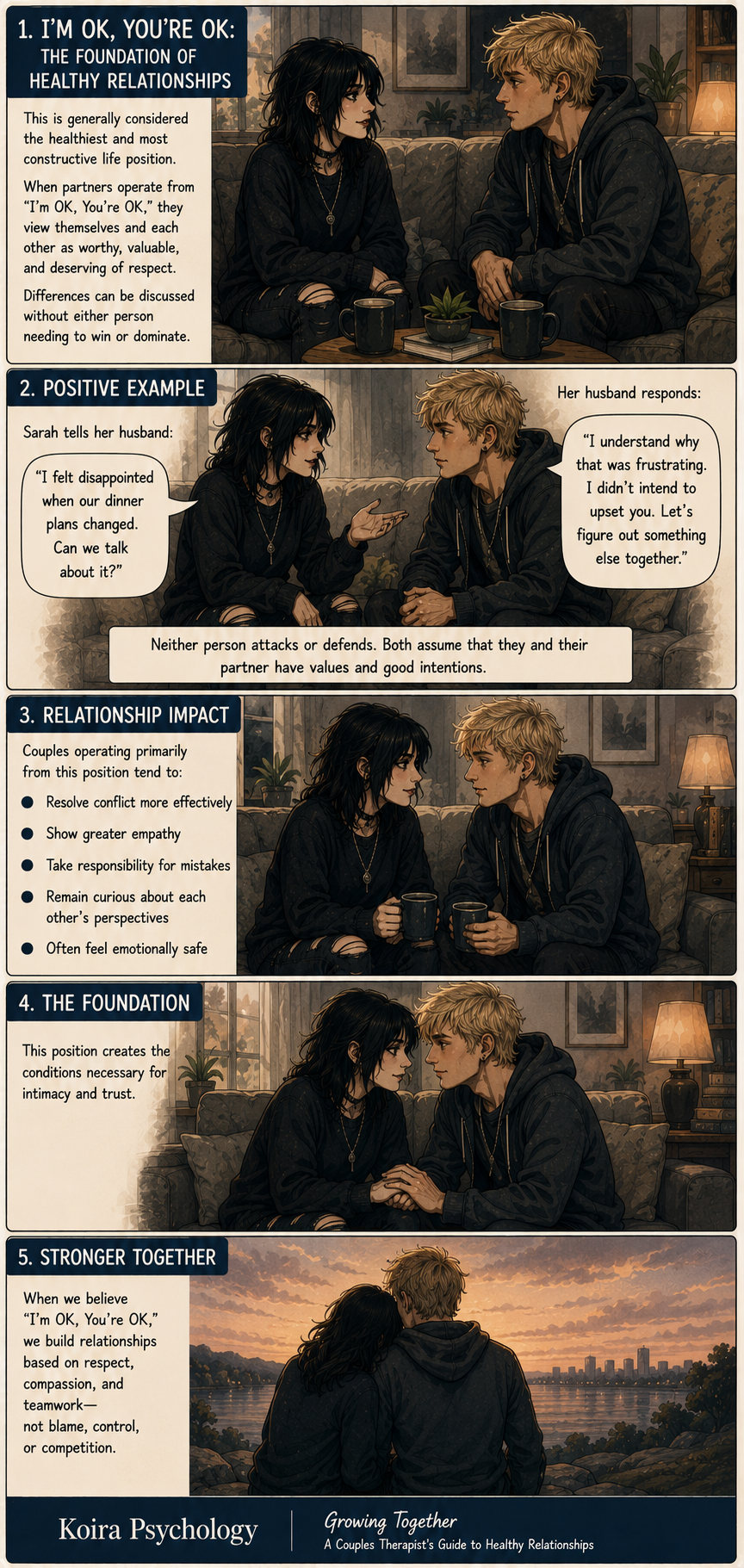
I'm OK, You're OK: The Foundation of Healthy Relationships
This is generally considered the healthiest and most constructive life position.
When partners operate from "I'm OK, You're OK," they view themselves and each other as worthy, valuable, and deserving of respect. Differences can be discussed without either person needing to win or dominate.
Positive Example
Sarah tells her husband:
"I felt disappointed when our dinner plans changed. Can we talk about it?"
Her husband responds:
"I understand why that was frustrating. I didn't intend to upset you. Let's figure out something else together."
Neither person attacks or defends. Both assume that they and their partner have values and good intentions.
Relationship Impact
Couples operating primarily from this position tend to:
● Resolve conflict more effectively
● Show greater empathy
● Take responsibility for mistakes
● Remain curious about each other's perspectives
● Often feel emotionally safe
This position creates the conditions necessary for intimacy and trust.
I'm OK, You're Not OK: The Position of Criticism and Contempt
In this position, a person sees themselves as competent, reasonable, or superior while viewing their partner as incapable, incompetent, or inadequate.
This stance often emerges when people feel frustrated, hurt, or fearful, but over time it can become a habitual way of relating.
Negative Example
One partner says:
"Why can't you ever do anything properly? If I don't handle everything, it falls apart."
The underlying message is:
"I'm competent. You're incompetent." or
“I have superior abilities when compared to you”
The other partner may respond with defensiveness, withdrawal, or counterattack.
Relationship Impact
When this position dominates:
● Criticism increases
● Respect decreases
● Resentment builds
● Contempt develops
● Power struggles emerge
● Emotional distance grows
Many distressed couples become trapped in cycles where one partner increasingly adopts an "I'm OK, You're Not OK" position while the other feels devalued.
I'm Not OK, You're OK: The Position of Insecurity
This position involves viewing oneself as inadequate while idealising or elevating the other person.
People operating from this stance often struggle with self-confidence and may fear rejection or abandonment.
Negative Example
A wife notices her husband is quiet after work and immediately thinks:
"I must have done something wrong."
Rather than asking, she becomes anxious and apologetic.
Meanwhile, her husband is simply tired.
The underlying belief is:
"You're better than me. Something must be wrong with me."
Relationship Impact
This position can lead to:
● Excessive reassurance-seeking
● Fear of conflict
● Difficulty expressing needs
● People-pleasing
● Emotional dependency
Although it may appear less harmful than criticism, it often creates imbalance within the relationship.
Healthy intimacy requires both partners to believe their thoughts, feelings, and needs matter.
I'm Not OK, You're Not OK: The Position of Hopelessness
This position reflects a loss of faith in both oneself and others.
People operating from this stance often feel defeated, discouraged, or emotionally shut down.
Negative Example
After years of unresolved conflict, one partner says:
"What's the point of talking? Nothing ever changes."
The other replies:
"You're right. We're just going to keep hurting each other."
Neither person believes they can improve the situation.
Neither person believes the other can either do anything about it.
Relationship Impact
This position often contributes to:
● Emotional withdrawal
● Cynicism
● Resignation
● Chronic conflict and mutual blaming cycles
● Relationship breakdown
Many couples arrive in therapy after spending significant time in this position.
The encouraging news is that it is not permanent.
Moving Toward "I'm OK, You're OK"
One of the primary goals of couples therapy is helping partners move toward an "I'm OK, You're OK" stance.
This does not mean pretending everything is fine or avoiding conflict. Instead, it means holding two important truths simultaneously:
● My needs, feelings, and experiences matter.
● Your needs, feelings, and experiences matter too.
From this position, conflict becomes less about proving who is right and more about understanding what is happening between two valuable people.
When couples learn to recognise the life positions influencing their interactions, they gain a powerful tool for change. Rather than reacting automatically, they can begin asking:
"Which position am I operating from right now?"
That simple question can transform a criticism into a conversation, a defence into curiosity, and a conflict into an opportunity for connection.

Key Points
Our beliefs about ourselves and others shape how we relate.
Transactional Analysis suggests that recurring relationship patterns are often influenced by underlying "life positions" that affect how we interpret ourselves, our partner, and conflict."I'm OK, You're OK" creates the foundation for healthy relationships.
This position allows both partners to see themselves and each other as worthy, valuable, and deserving of respect, making empathy, accountability, and collaboration possible."I'm OK, You're Not OK" often leads to criticism and contempt.
When one partner views themselves as superior and the other as inadequate, respect diminishes and power struggles, resentment, and emotional distance grow."I'm Not OK, You're OK" can create insecurity and dependency.
Viewing oneself as less worthy than a partner can lead to people-pleasing, excessive reassurance-seeking, fear of conflict, and difficulty expressing personal needs.Awareness of life positions can help couples change destructive patterns.
Recognising the position we are operating from allows us to shift from automatic reactions toward greater curiosity, empathy, and mutual understanding.
Self-Reflection Questions
When conflict arises, which life position do I tend to fall into most often: "I'm OK, You're OK," "I'm OK, You're Not OK," "I'm Not OK, You're OK," or "I'm Not OK, You're Not OK"?
Do I ever find myself viewing my partner as the problem, or viewing myself as less capable or worthy than they are?
How does my underlying view of myself and my partner influence the way I communicate during disagreements?
What would change in our relationship if I approached difficult conversations from an "I'm OK, You're OK" mindset?
-
Add a short summary or a list of helpful resources here.