Module 2: Creating Safety and Connection
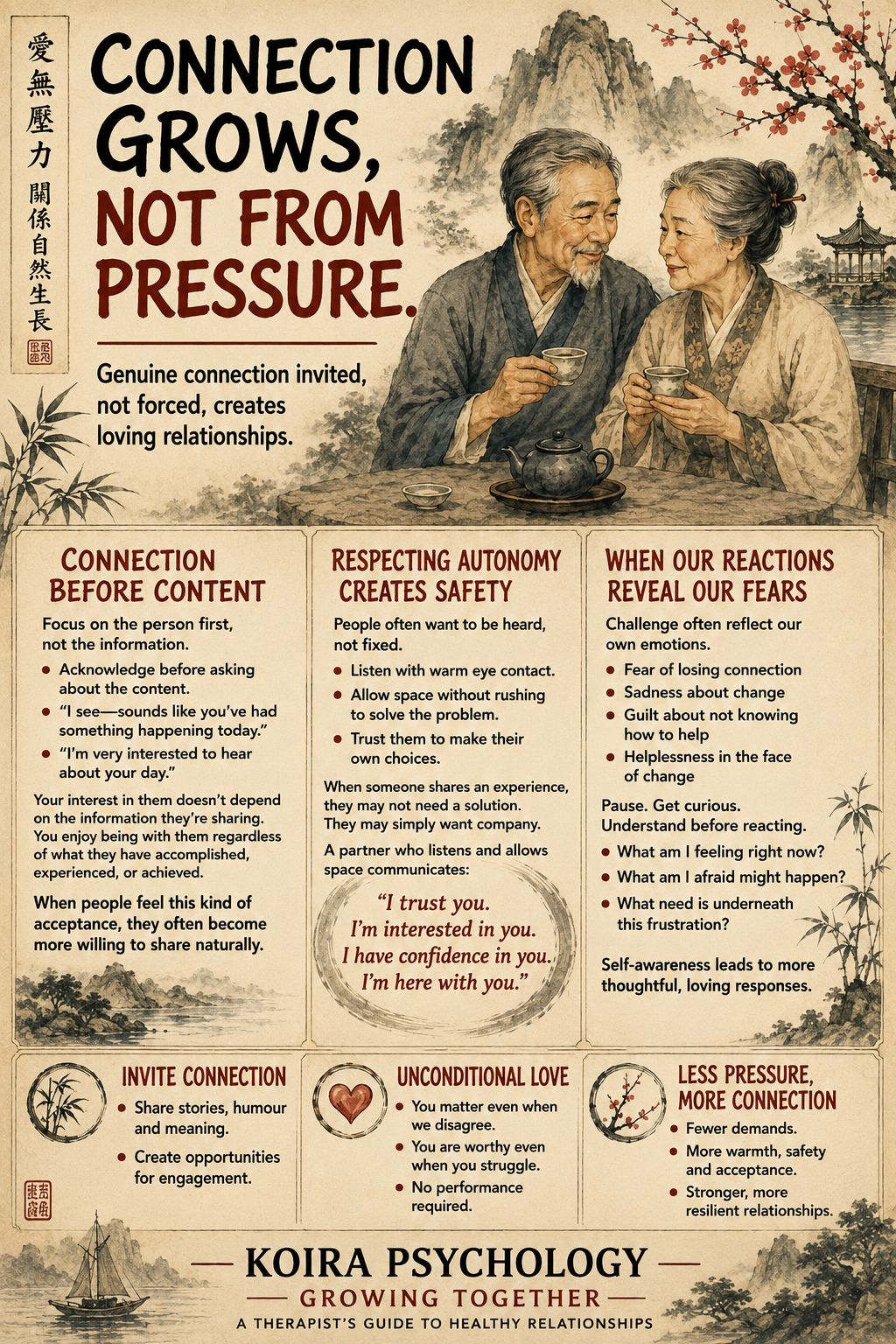
As a couple’s therapist, I often meet people who desperately want closer, more loving relationships with their partner, children, or family members. They want more connection, more warmth, and a greater sense of being valued. Yet despite these good intentions, they often find themselves caught in patterns of frustration, criticism, advice-giving, or attempts to influence the behaviour of the people they love.
What I have come to believe is that one of the most powerful ways to improve relationships is to develop a new habit: making our love visible in ways that can be experienced as unconditional.
This does not mean becoming passive or ignoring problems. Rather, it means learning to communicate, listen, and respond in ways that allow the other person to feel accepted as a person, separate from their achievements, behaviours, or choices.
Over time, this approach not only strengthens relationships with others but also helps us develop a healthier relationship with ourselves.
Connection Before Content
Many relationship difficulties emerge when we focus more on information than connection.
Imagine your partner walks into the room and says:
"I was on the phone to Sarah."
At first glance, this appears to be a simple statement about a phone call. But often, beneath the words is something more important: a bid for connection-I want to tell you about my need to talk earlier with Sarah, and now with you.
Many of us respond automatically by focusing on the content.
"What was the call about?"
"Did you have something important to share with her?"
"Ok, is that call something to do with me?"
While these responses may seem harmless, they can sometimes shift attention away from the person and onto the event.
A different approach is to first acknowledge the person before exploring the content.
"I see-Sounds like you've had something happening today. "
"I’m very interested to hear about your day."
You are interested in the content because you are curious about the person. You communicate your interest in your partner does not depend on the information they are sharing. You enjoy being with them regardless of what they have accomplished, experienced, or achieved.
When people feel this kind of acceptance, they often become more willing to share naturally.
Respecting Autonomy Creates Safety
One of the most overlooked aspects of healthy relationships is respect for autonomy.
Many of us have been taught that love means helping, fixing, advising, identifying areas for improvements, or directing. Yet unsolicited advice can sometimes communicate a hidden message:
"I don't trust you to handle this yourself."
"I know what’s best for you."
Relationships often become stronger when we balance our desire to help our partner with our ability to accept they are separate entities to us and thus are fully capable and responsible for making their own choices, even when these choices aren’t your preferred ones.
When someone shares an experience, they may not need a solution. They may simply want company.
A partner who listens attentively, maintains warm eye contact, and allows space without rushing to solve the problem often communicates something profoundly reassuring:
"I trust you. I'm interested in you. I have confidence in you. I'm here with you."
When Our Reactions Reveal Our Fears
Relationship challenges often tell us as much about ourselves as they do about the other person.
Consider a parent who becomes frustrated because their teenager is constantly looking at their phone during dinner.
The instinctive reaction may be to impose rules, issue demands, or remove the phone altogether.
While these actions might create immediate compliance, they often fail to address the emotional experience underneath.
If the parent pauses and reflects, they may discover feelings such as:
● Fear that they are losing connection with their child.
● Sadness that family time feels different than it once did.
● Guilt about not knowing how to help.
● Helplessness in the face of change.
These emotions can be difficult to tolerate. As a result, many people attempt to regain control of the situation by focusing on the content (in this case, phone usage at dinner time) rather than understanding the need to re-establish connection.
Yet relationships often improve when we first acknowledge our own emotional experience.
Instead of reacting to the discomfort, we become curious about it.
"What am I feeling right now?"
"What am I afraid might happen?"
"What need is underneath this frustration?"
This self-awareness creates space for more thoughtful and loving responses.
The Habit That Changes Relationships

Key Points
Relationships improve when love is experienced as unconditional
Stronger relationships are built when people feel accepted and valued for who they are, not for what they achieve, how they behave, or whether they meet our expectations. Making love visible through acceptance helps create deeper trust and connection.Connection is often more important than content
Many conversations contain a hidden bid for connection beneath the words. Rather than focusing immediately on facts, problems, or information, healthy relationships involve responding to the person first. Showing interest in the person behind the story helps people feel seen, valued, and understood.Respecting autonomy strengthens relationships
Love is not always about fixing, advising, or directing others. Unsolicited advice can unintentionally communicate a lack of trust in the other person's ability to manage their own life. Relationships become safer and more supportive when we listen with curiosity, trust, and confidence in the other person's capacity to make their own choices.Many relationship reactions are driven by underlying emotions
Frustration, criticism, or attempts to control others are often responses to deeper feelings such as fear, sadness, guilt, or helplessness. By becoming curious about our emotional reactions, we can better understand what is happening within us and respond more thoughtfully.Self-awareness creates more loving responses
When we pause to ask ourselves what we are feeling, what we fear, and what need lies beneath our reaction, we create space for greater emotional wisdom. This self-awareness allows us to move from controlling or reactive behaviours toward responses that foster connection, understanding, and emotional safety.
Self-Reflection Questions
When someone I love shares something with me, do I focus primarily on the information they are giving, or on connecting with them as a person?
How often do I offer advice, solutions, or corrections when what the other person may really need is understanding, attention, or companionship?
What emotions tend to sit beneath my frustration, criticism, or desire to control situations in my relationships?
How can I communicate more clearly to the people I love that their worth and belonging are not dependent on meeting my expectations?
-
Add a short summary or a list of helpful resources here.