Module 2: Creating Safety and Connection
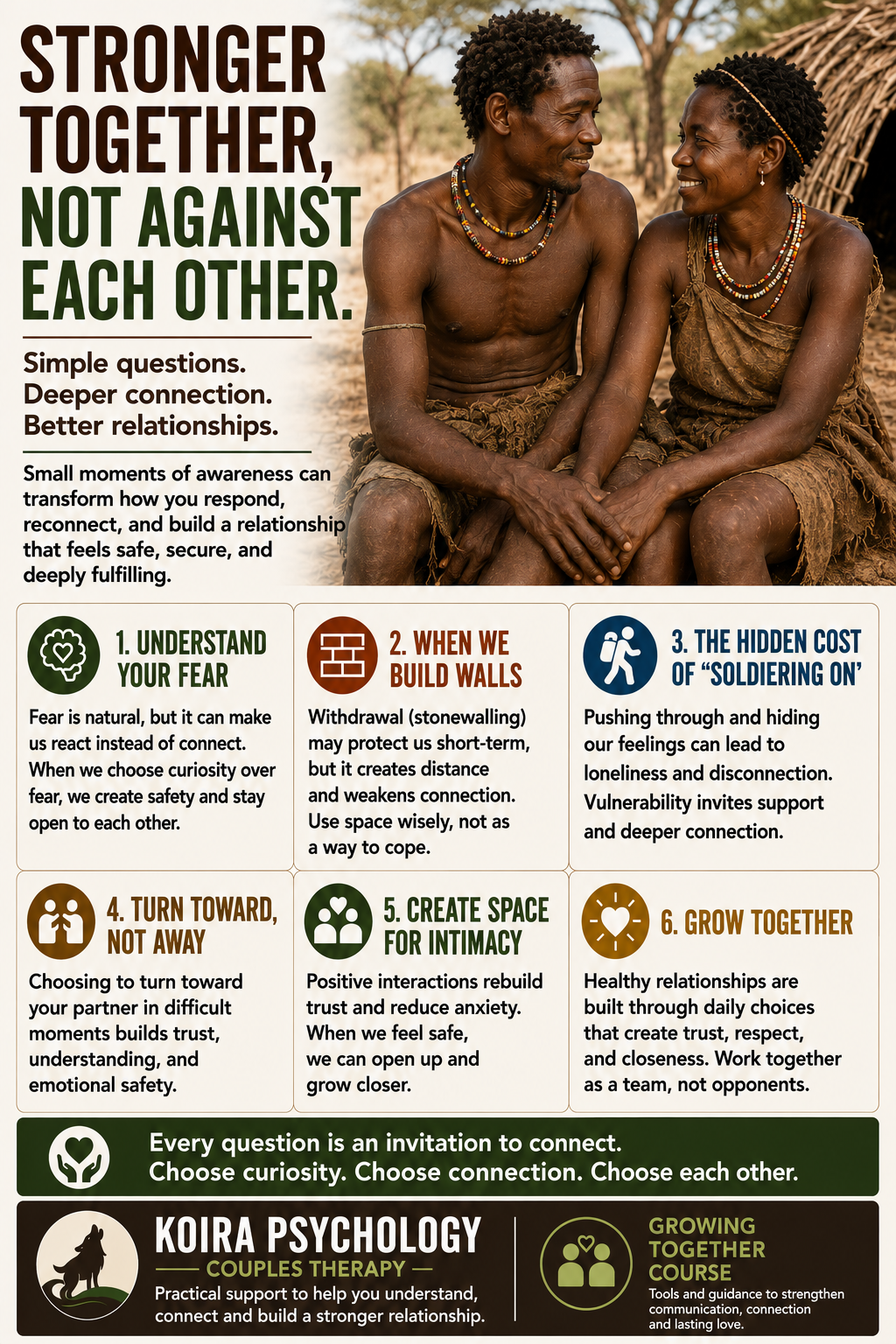
As a couple’s therapist, I often find that meaningful change begins not with learning a complicated communication technique, but with developing a new way of relating to ourselves and each other.
One approach I frequently encourage couples to practise is what I call the "What Would Happen If?" and "How Would?" habit.
At first glance, these may seem like simple questions. Yet they have the power to interrupt automatic reactions and create space for more thoughtful, secure, and compassionate responses.
When both partners increase awareness of their own responding patterns, they are more likely to move forward feeling connected, supported, and on the same team.
In contrast, when we repeatedly engage in blaming, defensiveness, counterattacking, stonewalling, withdrawing, or self-victimising, we gradually erode the warmth and closeness we long for. Every interaction may seem small in isolation, but over time these patterns can create significant emotional distance.
The good news is that secure relating can be learned. It begins by building upon the foundation that already exists within us.
Understanding the Role of Fear
One of the greatest barriers to secure connection is fear.
Fear is a natural and important human emotion. When we perceive a threat, our nervous system prepares us to fight, flee, or freeze to protect ourselves. This response is designed to help us survive difficult situations.
The challenge is that relationship difficulties can also trigger this survival system.
When trust has been damaged, communication has deteriorated, and opportunities for repair have become less frequent, partners often begin to operate from an underlying sense of fearfulness. They may fear rejection, criticism, abandonment, failure, disappointment, or emotional pain.
When this happens, the relationship itself can begin to feel unsafe.
Over time, these fears can become internalised, leading partners to withdraw further from one another rather than move closer.
One way to interrupt this pattern is through curiosity.
Instead of reacting automatically, we might ask:
● What would happen if I allowed myself to feel this fear without shutting down?
● How would staying present help me remain connected to my partner?
● What would happen if I acknowledged my feelings of shame, anger, sadness, guilt, fear, or joy as they arise?
● How would understanding my emotions help me understand myself more fully?
● What would happen if I developed greater trust in myself?
● How would greater self-confidence influence my confidence in my partner?
These questions invite reflection rather than reaction.
When We Build Walls
Many couples become trapped in a cycle where one partner protects themselves through withdrawal.
This pattern is often referred to as stonewalling.
Stonewalling can provide temporary relief. When we build emotional walls, we feel protected from disappointment, conflict, vulnerability, or criticism.
The wall serves a purpose.
However, what begins as protection can gradually become isolation.
The more frequently someone retreats behind the wall, the more familiar and comfortable that strategy becomes. Over time, they may find it increasingly difficult to reveal themselves fully to those they love.
Sometimes withdrawing is appropriate. Everyone needs space to regulate emotions and gather their thoughts. The question is whether withdrawal is being used intentionally and temporarily, or whether it has become the primary strategy for coping with discomfort.
In my experience, feeling safe is important, but feeling secure is even more valuable.
Safety often comes from avoiding threat. Security comes from developing confidence that we can remain connected even when challenges arise.
Every secure interaction strengthens the possibility of another secure interaction. With practice, this creates a foundation for healthier and more satisfying relationships.
The Hidden Cost of "Soldiering On"
When one partner withdraws, the other often responds in a very different way.
Rather than shutting down, they "soldier on."
They maintain a positive appearance, continue functioning, and present themselves as coping well.
To outside observers, everything may appear normal.
Yet beneath the surface, there may be sadness, loneliness, fear, disappointment, or grief.
The challenge with soldiering on is that it often requires people to hide parts of themselves. They continue moving forward but rarely allow others to see their vulnerability.
While this strategy can help someone regulate difficult emotions in the short term, it may also reduce opportunities for support, understanding, and genuine connection.
Reflection can again help create alternatives:
● What would happen if I used a different strategy when I experience self-doubt?
● How would this help me feel more secure with others?
● What would happen if I allowed trusted people to see the parts of myself I usually hide?
● How would accepting my vulnerability help me accept myself?
● What would happen if I trusted that I could be seen without being rejected?
● How would this help me feel closer to others?
Turning Toward Rather Than Away
One of the strongest predictors of relationship success is the ability to turn toward each other during moments of uncertainty.
When we feel hurt, anxious, misunderstood, or disconnected, our instinct is often to retreat or protect ourselves.
Yet secure relationships are built when partners repeatedly choose connection over avoidance.
This does not mean agreeing with everything your partner says or suppressing your own needs. It means remaining emotionally available even when differences exist.
A powerful question to ask is:
● What would happen if I turned toward my partner rather than away from them?
● How would this help me experience warmth, love, understanding, and acceptance?
Small moments of turning toward each other accumulate over time and create lasting emotional security.
Creating Space for Deeper Intimacy
Unless a relationship involves abuse or ongoing harm, I generally encourage couples to approach difficulties as allies rather than adversaries.
Healthy relationships are strengthened when partners see one another as teammates working toward a shared goal rather than opponents trying to win a competition.
Through regular positive interactions, trust begins to rebuild. Anxiety decreases. Defensiveness softens. Openness grows.
As this occurs, partners often become more willing to invite each other into their inner worlds.
This is where deeper intimacy develops.
To support this process, consider asking:
● What would happen if I focused on positive relating instead of instinctive reactions?
● How would this help me navigate conflict more effectively?
● What would happen if I approached my partner's perspective with curiosity, compassion, and empathy?
● How would this improve my listening and understanding?
● What would happen if I practised saying "no" without becoming defensive?
● How would this help us manage differences respectfully?
A New Habit for Creating Closeness

Five Key Points
Secure relationships are built through awareness of our own responding patterns, not through changing our partner’s.
Fear often sits underneath withdrawal, defensiveness, criticism, and emotional distance.
Stonewalling and "soldiering on" are protective strategies that can unintentionally block deeper connection.
Asking "What would happen if?" creates space for reflection, flexibility, and more secure responses.
Lasting intimacy develops when partners repeatedly choose curiosity, vulnerability, compassion, empathy, and connection over protection and withdrawal.
Self-Reflection Questions
When I feel hurt, criticised, anxious, or disconnected, do I tend to react automatically or pause and become curious about what I am feeling?
What fears most commonly influence my behaviour in relationships (e.g., rejection, abandonment, criticism, shame, failure, or vulnerability)?
Do I cope with discomfort by withdrawing, building emotional walls, or "soldiering on," and how might these strategies affect my connection with others?
What would happen if I intentionally turned toward my partner during moments of uncertainty rather than away from them?
-
Add a short summary or a list of helpful resources here.