Module 1: Understanding Relationships
In today’s world, there is no shortage of relationship advice. Books, podcasts, social media posts, and videos offer insights into communication, attachment styles, conflict resolution, and emotional regulation. Many of these resources are genuinely helpful. They can give couples language for what they are experiencing, normalise their struggles, and offer useful frameworks for understanding patterns.
However, there is an important limitation that is often overlooked: knowing about relationships is not the same as understanding your relationship.
The Gap Between Knowledge and Experience
Reading about attachment theory, communication styles, or conflict cycles can give couples valuable insight into what might be happening. But it does not always reveal how it is happening between you and your partner in real time.
For example, a partner might understand intellectually that they have an anxious attachment style. They may even recognise reassurance-seeking behaviours in themselves. Yet in the heat of a disagreement, when their partner is emotionally distant, that knowledge often disappears. What takes over instead is fear, urgency, or protest behaviour.
This is because relationships are not just rational cognitive systems. They are emotional, embodied, and interactive systems that activate deep patterns under stress.
Why Self-Help Alone Reaches Its Limit
Self-help resources tend to assume that insight automatically leads to change. In reality, insight is only the first step.
Some of the most common limitations include:
● You can understand a concept but still miss seeing it when it is happening in the moment
● You may interpret your partner through your own emotional filter rather than what’s present in reality
● You may not see how your behaviour triggers a predictable response in your partner
● You may have blind spots that feel completely justified from your own perspective
For instance, someone might read about “criticism vs. complaint” and believe they are simply expressing needs. But their partner may experience tone, timing, or repetition as criticism, leading to defensiveness and withdrawal.
Both perspectives can feel true, yet the interaction itself is what matters.
The Relationship as a System, Not Two Individuals
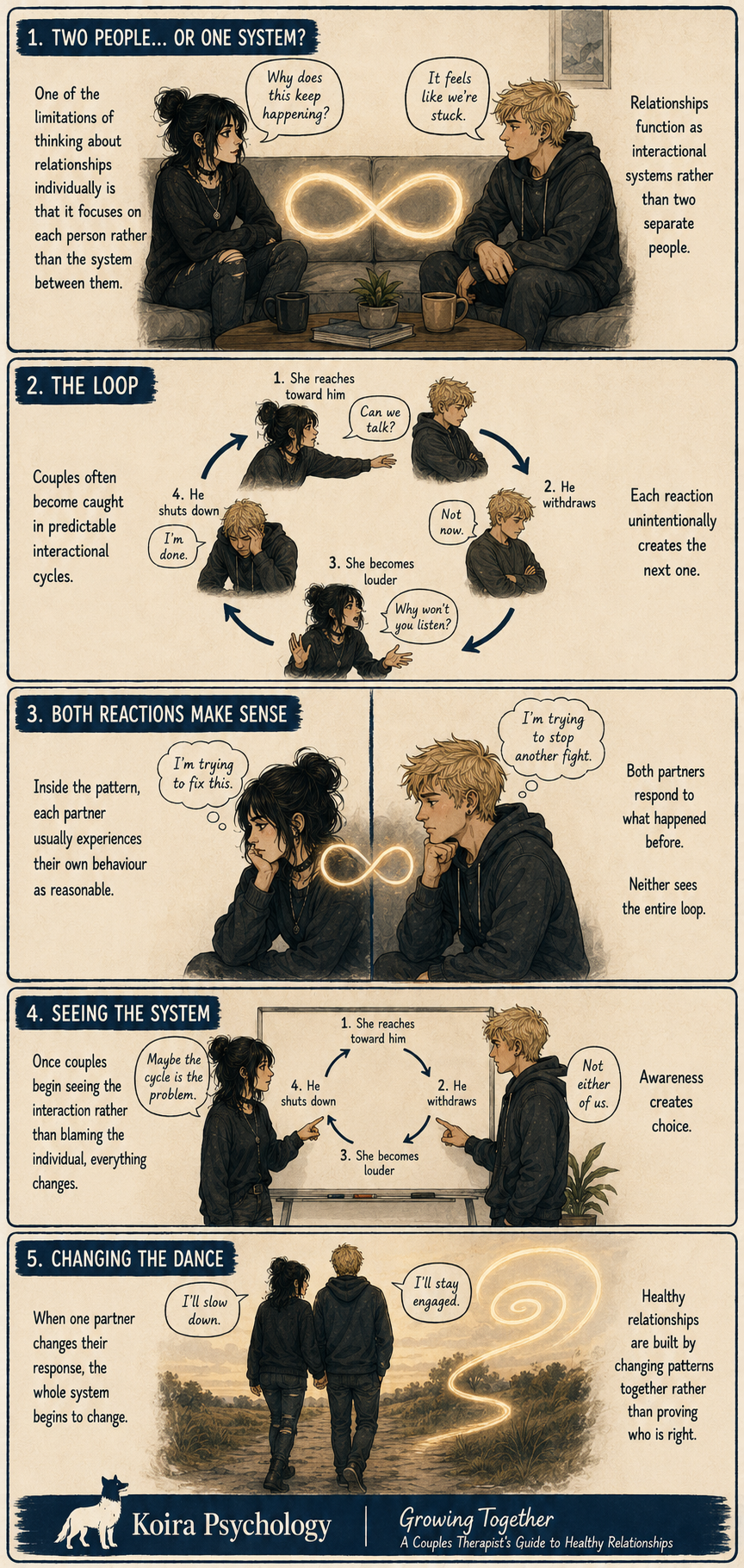
One of the key limitations of learning about relationships in isolation is that it focuses on individuals rather than the system between them.
In reality, couples operate as an interactional loop:
● One partner pursues → the other withdraws
● One criticises → the other defends
● One shuts down → the other escalates
These cycles are often invisible from the inside. Each partner tends to see their own reaction as reasonable and the others as the problem. Without an outside perspective, the pattern repeats.
What Couples Therapy Adds That Books Cannot
Couples therapy is not simply “more information.” It is a different kind of understanding altogether.
A therapist helps couples see:
1. The interaction in real time
Instead of describing the relationship, therapy observes how it unfolds moment by moment. Subtle shifts in tone, timing, withdrawal, and escalation become visible when pointed out by the therapist.
2. The cycle rather than the individual
Therapy shifts attention from “who is right” to “what is happening between us.” This reduces blame and increases clarity.
3. Blind spots that cannot be self-observed
Every person has emotional blind spots; patterns that feel normal internally but have a strong impact externally. A partner may not realise they interrupt when anxious, or withdraw when overwhelmed, or become critical when afraid.
4. Emotional meaning beneath behaviour
What looks like anger may be fear. What looks like withdrawal may be self-protection. What looks like indifference may be feeling overwhelmed. Therapy helps translate behaviour into emotional meaning.
Examples of Blind Spots in Relationships
● A partner reads extensively about communication and believes they are “clear,” but their tone feels sharp, leading to defensiveness in their partner.
● A partner identifies as “easy-going,” but actually avoids conflict, causing unresolved issues to build resentment in the relationship.
● A partner believes they are “helping” by giving advice, but their partner experiences it as criticism, overstepping, or ack of empathy.
● Both partners agree on principles like “active listening,” but in conflict, they revert to old survival patterns.
These are not failures of intelligence or effort. They are examples of how emotional systems override intellectual knowledge.
Why Being Seen Matters
One of the most powerful aspects of couples therapy is not just learning new ideas but being seen in the relational process itself.
Many couples say things like:
● “I didn’t realise I was doing that.”
● “I thought I was being clear, but I can see how it lands differently.”
● “I didn’t see the cycle we were stuck in until now.”
This shift from explanation to observation in Couples Therapy is often where real change begins.
From Knowing About Relationships to Living Them Differently
Books, articles, and videos are valuable entry points. They help couples make sense of their struggles and reduce shame. But they cannot fully capture the complexity of two nervous systems interacting under stress, history, and emotion.
Couples therapy bridges this gap. It brings awareness into the lived, emotional experience of the relationship. It helps couples not only understand concepts, but see themselves in action, and see each other more clearly.
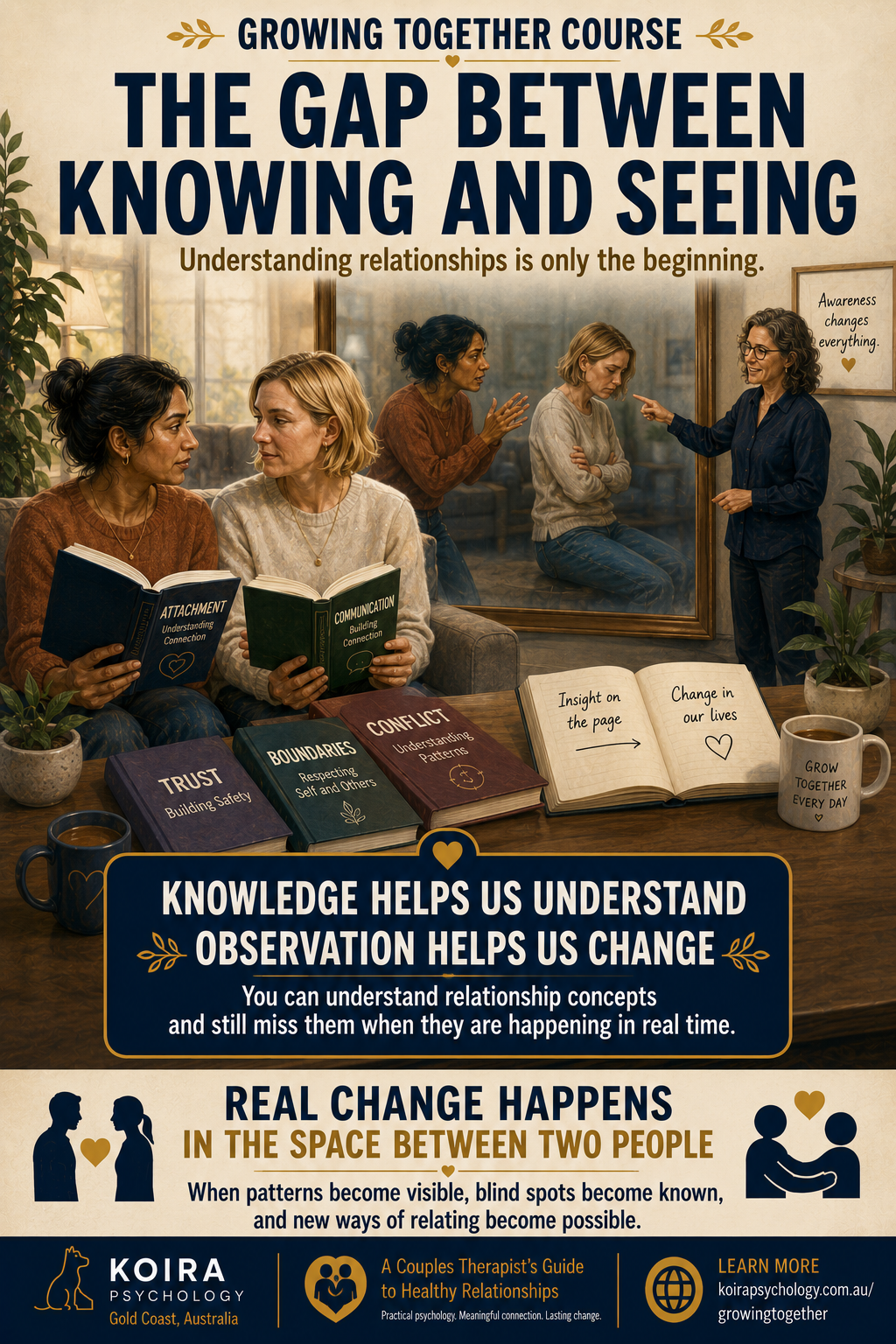
Relationship knowledge is helpful, but it is incomplete on its own. Real change happens when understanding moves from the page into the space between two people.
In that space, patterns become visible, blind spots become known, and new ways of relating become possible.
Key Points
Relationship knowledge is helpful, but insight alone rarely creates change.
Understanding concepts such as attachment styles or communication patterns does not automatically translate into different behaviour during emotionally charged moments.Relationships are emotional systems, not just rational conversations.
Under stress, people often react from deeply ingrained emotional patterns rather than from what they intellectually know to be true.Couples can become trapped in invisible interaction cycles.
Patterns such as pursuing and withdrawing, criticising and defending, or escalating and shutting down often sustain relationship difficulties more than either individual partner's behaviour alone.Blind spots are difficult to recognise without outside perspective.
People may be unaware of how their tone, behaviours, or coping strategies affect their partner and contribute to recurring relationship problems.Couples therapy helps transform awareness into change.
By observing interactions in real time, identifying cycles, and uncovering the emotional meaning beneath behaviours, therapy helps couples move from understanding concepts to living differently.
Self-Reflection Questions
Are there recurring patterns in our conflicts that we can recognise, even if we struggle to change them?
What might I be contributing to relationship difficulties that is harder for me to see than it is for my partner?
When conflict arises, do I respond according to what I know is helpful, or according to my emotional reactions in the moment?
Do we tend to focus on who is at fault, or on understanding the cycle that keeps us stuck?
-
Add a short summary or a list of helpful resources here.