Module 2: Creating Safety and Connection
Most couples assume that their difficulties arise because they disagree about important issues. While disagreements certainly matter, the real problem often begins much earlier.
It starts when something one partner says, does, or fails to do triggers an emotional response in the other person.
A comment, a tone of voice, a forgotten task, a delayed reply, or a perceived lack of interest can all act as emotional triggers.
The challenge is that many people notice the anxiety that follows but fail to recognise the underlying feelings that are driving it.
As a result, couples can become trapped in cycles of confusion, defensiveness, arguments, and emotional disconnection without fully understanding what is happening.
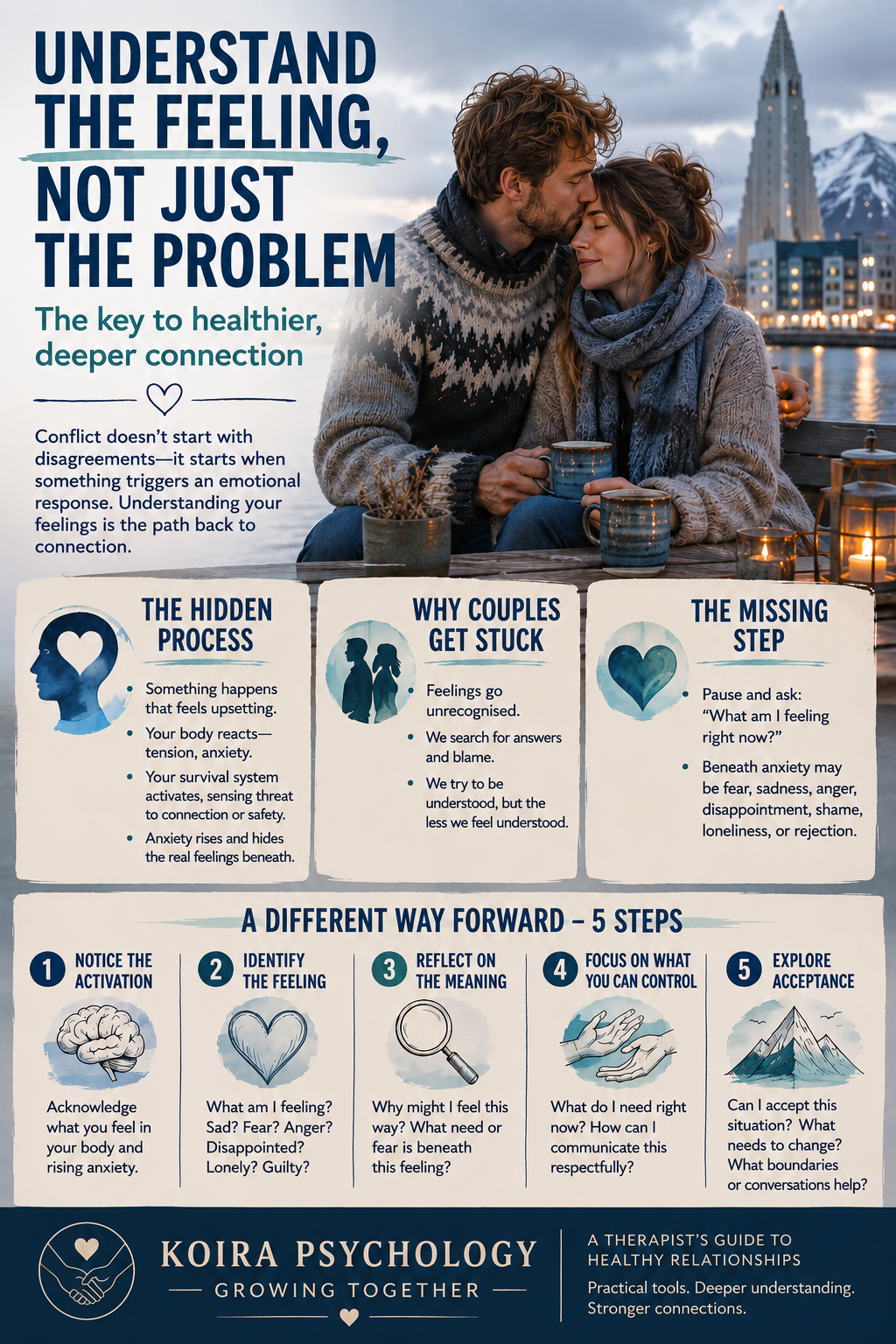
The Hidden Process Behind Relationship Conflict
For many people, the sequence looks something like this.
Something happens in the relationship that feels upsetting, disappointing, confusing, or threatening.
Almost immediately, the body responds.
There may be tension in the chest, a knot in the stomach, racing thoughts, restlessness, or a feeling of urgency.
These sensations are signals from the nervous system, alerting us that something important may require attention.
Our survival system becomes activated.
Although there may be no actual danger, the brain interprets the situation as a potential threat to something deeply important, such as connection, acceptance, trust, belonging, or security.
At this point, anxiety begins to rise.
The difficulty is that anxiety often becomes so prominent that it overshadows the emotions underneath it.
Rather than recognising feelings such as anger (frustration is a form of anger), fear, sadness, disappointment, shame, loneliness, or rejection, people become focused on the discomfort of the anxiety itself.
Why Couples Get Stuck
When feelings remain unrecognised, the mind naturally tries to make sense of what is happening.
This often leads people to search for answers.
They ask more questions.
They analyse conversations.
They replay events.
They seek explanations.
They try to figure out who is right and who is wrong, or who is more responsible for the problem.
Unfortunately, this process rarely creates the certainty they are seeking.
Instead, the conversation can become increasingly focused on content rather than emotion.
Partners begin debating details, intentions, and interpretations.
Each person attempts to explain why only their perspective makes sense.
Without realising it, the discussion gradually shifts from understanding each other to proving a point.
The result is a pattern that many couples know well.
The more each person tries to be understood, the less understood both people feel.
The more they argue about the facts, the further away they move from the emotions that need attention.
The Missing Step: Recognising the Feeling
In my experience, one of the most effective ways to interrupt this cycle is to develop greater awareness of emotions before becoming consumed by anxiety.
Rather than immediately focusing on what your partner did wrong or what the situation means, begin by paying attention to yourself.
Ask:
"What am I feeling right now?"
This sounds simple, but it is often surprisingly difficult.
Many people are highly skilled at identifying what they think, but much less practised at identifying what they feel.
Yet emotions contain important information.
Perhaps beneath the anxiety is fear of rejection.
Perhaps there is sadness about feeling disconnected.
Perhaps there is disappointment, embarrassment, loneliness, guilt, resentment, or shame.
Once a feeling is recognised, it can begin to be understood.
A Different Way Forward
The next time you find yourself becoming emotionally activated, consider following a different sequence.
1. Notice the Activation
Instead of reacting immediately, simply acknowledge that something within you has been triggered.
Recognise the physical sensations and rising anxiety without rushing to act on them.
2. Identify the Feeling
Ask yourself:
● What am I feeling right now?
● Is it sadness?
● Fear?
● Anger?
● Disappointment?
● Embarrassment?
● Guilt?
● Shame?
● Loneliness?
The goal is not to judge the feeling but simply to recognise it.
3. Reflect on the Meaning
Once you identify the emotion, become curious about it.
Ask:
● Why might I be feeling this way?
● What does this situation remind me of?
● What fear or need might be underneath this feeling?
This process helps transform emotional reactivity into self-understanding.
4. Consider What Is Within Your Control
Rather than focusing entirely on changing your partner, ask:
● What do I need right now?
● How can I communicate this respectfully?
● What response would help me stay connected rather than become defensive?
This shifts attention from blame to responsibility.
5. Explore Acceptance
Finally, ask yourself:
● Can I accept the reality of this situation?
● If not, what specifically needs to change?
● What boundaries, conversations, or adjustments might be necessary?
Acceptance is not resignation.
It is the willingness to see reality clearly before deciding how to respond.
Why This Approach Strengthens Relationships
When couples learn to identify and understand their feelings before reacting, several things begin to change.
Conversations become less defensive.
Arguments become less repetitive.
Compassion and empathy increases.
Partners become more capable of listening because they are less preoccupied with proving themselves right.
Most importantly, emotional safety begins to grow.
Instead of approaching each interaction as a problem to solve or a debate to win, partners learn to approach each other with greater curiosity and compassion.
The Real Goal
The goal is not to eliminate conflict.
Every healthy relationship contains disagreements, misunderstandings, and moments of frustration.
The goal is to develop the ability to recognise what is happening within yourself before reacting to what is happening around you.
When we understand our emotions, we become less avoidant of them.
When we become less avoidant of our emotions helps us be less controlled by the emotions, we become more capable of understanding our partner.
And when both partners can do this, the relationship becomes less about determining who is right and more about creating a deeper understanding of each other's emotional world.
This is often where lasting connection, trust, and intimacy begin.
One of the most common patterns I see as a couples therapist is not a lack of love, commitment, or good intentions. Rather, it is what happens when partners become emotionally activated and lose sight of what they are actually feeling.
Key Points
Relationship conflict is often driven by emotional activation rather than the issue itself.
Many arguments begin when a partner feels emotionally triggered, and the resulting anxiety takes over before the underlying feelings are recognised.Anxiety can mask deeper emotions.
Feelings such as fear, sadness, loneliness, shame, disappointment, or anger are often hidden beneath the urgency and discomfort of anxiety.Couples become stuck when they focus on facts instead of feelings.
Debating details, intentions, and who is right often distracts partners from understanding the emotions that are actually driving the conflict.Self-awareness helps interrupt reactive patterns.
Learning to identify emotions, reflect on their meaning, and consider what is within our control can transform conflict into an opportunity for understanding and growth.Emotional understanding creates stronger connection.
When partners approach themselves and each other with curiosity, compassion, and emotional awareness, conversations become less defensive and emotional safety grows.
Self-Reflection Questions
When I become upset with my partner, how quickly do I pause to identify what I am actually feeling beneath the anxiety or frustration?
Are there recurring emotions (e.g., fear, loneliness, shame, disappointment, or rejection) that tend to sit underneath our conflicts?
When we disagree, do I spend more energy trying to prove my point or trying to understand what I and my partner are feeling?
What helps me stay emotionally connected and thoughtful when I feel triggered or overwhelmed in the relationship?
-
Add a short summary or a list of helpful resources here.