Module 3: Communicating Effectively
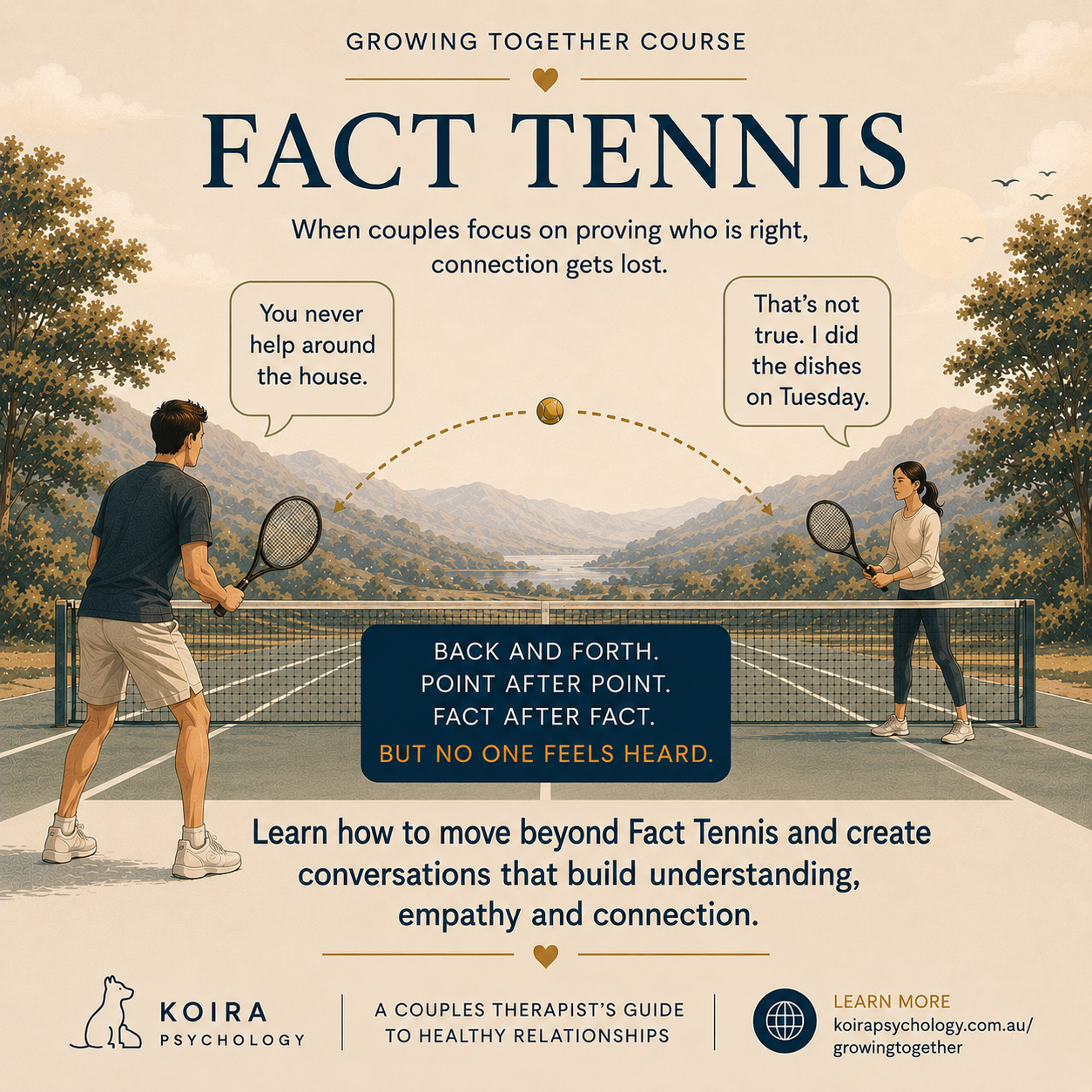
Fact tennis, a term described by therapist Philippa Perry, occurs when couples argue by trading facts and corrections instead of addressing emotions. While each partner tries to prove they are right, emotional understanding is lost. Over time, this creates defensiveness, invalidation, and disconnection. Healthier communication involves moving away from proving to relating toward curiosity, validation, empathy, and emotional connection.
In relationship therapy, one communication pattern that frequently appears during conflict is what therapist Philippa Perry describes as “fact tennis.” It is a common dynamic in long-term relationships, and while it often sounds rational and fair on the surface, it quietly erodes emotional connection over time.
Fact tennis occurs when partners begin hitting facts, corrections, evidence, and counter-evidence back and forth like a ball in a game of tennis. Instead of listening to understand one another’s perspective and emotional experience, each person becomes focused on proving their version of events is the accurate one.
The discussion shifts away from a healthy interaction and into a courtroom debate.
Fact tennis is rarely about the facts themselves. More often, it reflects a deeper struggle around feeling unseen, blamed, misunderstood, or emotionally unsafe
What Fact Tennis Looks Like
A conversation may begin with a feeling:
“I felt hurt when you didn’t respond to my message.”
But instead of responding to the emotion, the other partner replies with evidence:
“That’s not true. I replied three hours later.”
The first partner then counters:
“Yes, but this is not the first time you responded late.”
The second responds:
“Well last week you ignored my message for five hours.”
Soon the conversation becomes a competitive exchange of details, timestamps, and historical examples. Both people are trying to establish who is objectively correct, while the original emotional content becomes lost.
No one feels heard because neither person is addressing the underlying feeling.
Why Couples Fall into Fact Tennis
Fact tennis is a learnt behaviour that is used because people instinctively learn to defend themselves when they feel criticised.
When one partner expresses disappointment, the other may unconsciously hear:
● “You’re failing.”
● “You’re a bad partner.”
● “You’re being blamed.”
As a result, they move into self-protection mode. Rather than becoming curious about their partner’s experience, they begin gathering evidence to defend their character or disprove the accusation.
This creates a cycle:
One partner expresses hurt.
The other partner defends with facts.
The first partner escalates to feel heard.
The second partner becomes more defensive.
Both partners stop listening emotionally.
The conversation becomes about accuracy instead of understanding.
The Problem With “Winning the Argument”
One of the difficulties with fact tennis is that it creates the illusion that if someone can simply explain themselves clearly enough, provide enough examples, or prove their memory is correct, the conflict will resolve.
But relational conflicts are not solved through cross-examination.
A person can be factually correct while still emotionally disconnected with the relational context.
For example, a fact tennis response could be:
“I said I’d be home around 6, and I got home at 6:20. So technically I wasn’t that late.”
While this may be accurate, it completely bypasses the partner’s emotional experience.
An emotionally attuned response might instead sound like:
“I can understand why my lateness felt disappointing for you. I should have communicated better.”
The second response prioritises connection over self-defence.
The Emotional Cost of Fact Tennis
Over time, repeated fact tennis can create several relational problems:
Emotional Invalidation
Partners begin feeling that their emotions are constantly debated rather than understood.
Escalation
When one partner does not feel emotionally acknowledged, they often intensify their argument in an attempt to finally be heard.
Defensiveness
Each conversation starts feeling like going into battle, leading both partners to prepare rebuttals instead of listening openly.
Loss of Intimacy
Emotional safety decreases when conversations feel adversarial rather than collaborative.
Eventually couples may begin avoiding vulnerable conversations altogether because they expect conflict rather than understanding.
Examples of Fact Tennis in Relationships
Example 1: Household Responsibilities
Partner A:
“I feel overwhelmed doing most of the housework.”
Partner B:
“That’s not true. I vacuumed on Saturday.”
Partner A:
“One time doesn’t count.”
Partner B:
“Well you never notice what I do.”
The discussion quickly becomes a scorekeeping exercise rather than an exploration of emotional needs.
Example 2: Feeling Ignored
Partner A:
“I feel like you haven’t been present with me lately.”
Partner B:
“We watched a movie together on Tuesday.”
Partner A:
“But you were on your phone half the time.”
Partner B:
“No I wasn’t.”
Now the conflict revolves around evidence and memory rather than loneliness or disconnection.
Moving Away from Fact Tennis
Healthy communication often requires partners to stop asking:
“Is my version correct?”
And instead ask:
“What is my partner experiencing emotionally?”
This does not mean agreeing with every interpretation or abandoning reality. It means recognising that emotional understanding matters more than factual victory.
A helpful shift is moving from:
● correcting → to curiosity
● defending → to understanding
● proving → to listening
For example:
Instead of:
“That never happened.”
Try:
“I remember it differently, but I can see it affected you strongly.”
Or instead of:
“You do the same thing.”
Try:
“I can hear that you felt alone in that moment.”
These responses reduce defensiveness and create emotional openness.
The Importance of Emotional Validation
One of the central principles in healthy relationships is that understanding someone’s feelings is not the same as admitting guilt.
Many couples become trapped because validation feels dangerous. They fear that acknowledging their partner’s pain means accepting total blame.
But emotional validation simply communicates:
“Your feelings make sense to me.”
This creates safety, which in turn allows more honest and less defensive conversations.
Ironically, when people feel emotionally understood, they often become less rigid and more open to hearing the other person’s perspective.
A More Helpful Goal
In healthy relationships, the goal of communication is not to determine who is objectively right about every detail. It is to deepen understanding, repair disconnection, and maintain emotional closeness.
Fact tennis may temporarily protect the self, but it usually weakens the relationship.
Couples who learn to pause their defensive reflexes and respond to the feeling beneath the complaint often discover that conflict becomes softer, shorter, and far more productive.
The healthiest conversations are rarely the ones where someone wins.
They are the ones where both people leave feeling understood.

Key Points
Fact tennis replaces emotional understanding with proving who is right
Instead of responding to feelings, couples begin exchanging facts, corrections, and counterarguments. The conversation shifts from emotional connection to debating accuracy.
Defensiveness often drives the pattern
When partners feel criticised, blamed, or misunderstood, they instinctively protect themselves by defending their version of events rather than becoming curious about their partner’s emotional experience.
Winning the argument does not resolve emotional disconnection
A person can be factually correct while still missing the emotional meaning underneath the conflict. Relationships are strengthened through empathy and understanding, not courtroom-style debates.
Fact tennis creates emotional distance over time
Repeated defensiveness and invalidation can lead to escalation, resentment, emotional exhaustion, and a loss of intimacy. Couples may eventually avoid vulnerable conversations altogether.
Healthier communication focuses on curiosity and validation
Strong relationships grow when partners move from correcting and defending toward listening, empathy, emotional validation, and understanding the feelings beneath the complaint.
Self-Reflection Questions
When my partner expresses hurt or disappointment, do I first respond to their feelings, or do I immediately begin explaining, correcting, or defending myself?
How often do our disagreements become debates about facts and details rather than discussions about what each of us is experiencing emotionally?
What emotions might I be protecting myself from when I feel the urge to prove that my version of events is correct?
How would our conversations change if my goal shifted from being right to helping my partner feel understood?
-
The Book You Wish Your Parents Had Read (and Your Children Will Be Glad That You Did) by Philippa Perry is available at Gold Coast Library as an e-book and audiobook