Module 3: Communicating Effectively
“We no longer plow the land together; today we talk. We have come to glorify verbal communication. I speak; therefore I am. We naively believe that the essence of who we are is most accurately conveyed through words.”
Esther Perel, Mating in Captivity
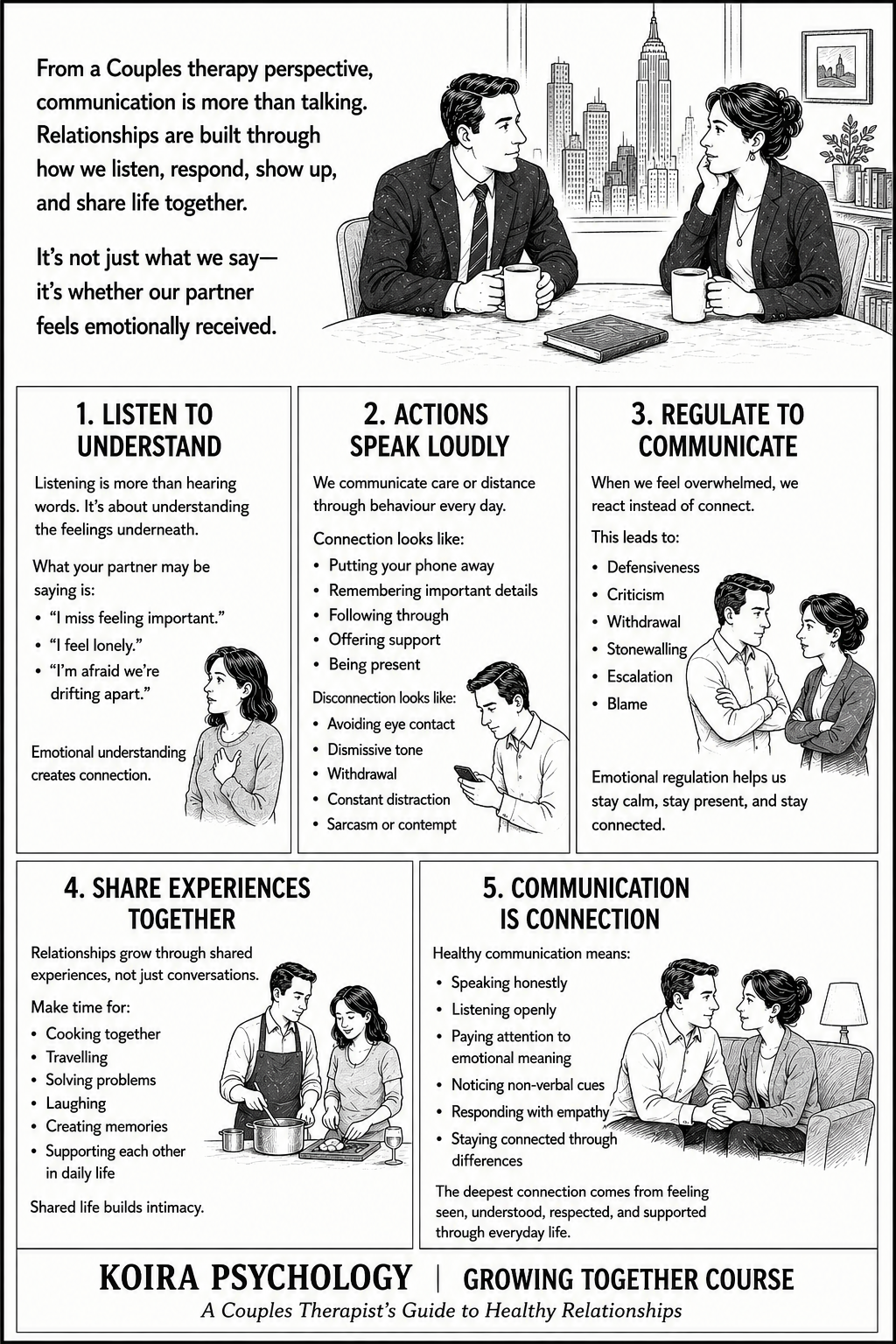
From a Couples therapy perspective, this quote highlights something many couples eventually discover, that communication is far more complex than simply talking, expressing feelings, or stating needs. While words are important, relationships are not healed or sustained through verbal expression alone. Human beings communicate constantly through tone, timing, body language, emotional presence, attentiveness, actions, silence, and the ability to listen and emotionally respond to one another.
Many modern relationships place enormous emphasis on verbal communication. Couples are often told that if they simply express themselves clearly enough, everything will improve. While emotional honesty is valuable, many partners become frustrated because they are “communicating” constantly yet still feel disconnected, misunderstood, or emotionally alone.
This is because communication is not only about speaking. It is also about whether the other person feels emotionally received.
The Importance of Listening
One of the most overlooked parts of communication is the ability to effectively listen. Many people listen while preparing a defence, waiting for their turn to speak, or searching for ways to correct the other person. Others listen only for the factual content of what is being said while missing the emotional meaning underneath it.
For example, when a partner says:
“You never spend time with me anymore,”
the deeper message may not literally be about time. It may be:
“I miss feeling important to you.”
“I feel lonely.”
“I am afraid we are drifting apart.”
If the listener responds only to the surface wording
“That is not true, we spent time together last week!”
the emotional meaning is missed entirely.
In therapy, couples often discover that feeling understood emotionally matters more than perfectly solving every issue immediately. Sometimes what a partner needs most is not advice, correction, or logic, but emotional acknowledgement:
“I can see you have been feeling disconnected lately.”
“That sounds painful.”
“I understand why that hurt you.”
This kind of listening helps create emotional safety and connection.
Communication Through Actions
Relationships are also deeply shaped by non-verbal communication. People communicate care, rejection, interest, resentment, safety, and affection through behaviour every day.
A partner who consistently puts their phone away during conversations communicates presence and attentiveness. A partner who remembers important details, follows through on commitments, or offers comfort during stress communicates care without needing many words at all.
Likewise, emotional distance is often communicated non-verbally
● Avoiding eye contact
● Dismissive tone
● Constant distraction
● Withdrawal after conflict
● Lack of responsiveness
● Sarcasm or contempt
Many couples focus heavily on “what was said” while underestimating how strongly emotional tone and behaviour shape relational experiences.
From a therapeutic perspective, words and actions need to align. Repeatedly saying “I love you” while behaving in emotionally dismissive or unreliable ways often creates confusion and mistrust.
Communication Requires Emotional Regulation
Another important aspect of communication is emotional regulation. We often believe communication problems are simply about wording or technique, when in reality the deeper difficulty is being emotionally overwhelmed.
When we feel attacked, ashamed, criticised, abandoned, or emotionally flooded, the nervous system shifts into protection mode. At that point, communication often becomes reactive rather than reflective:
● Defensiveness
● Criticism
● Withdrawal
● Stonewalling
● Escalation
● Blame
In these moments, couples are often no longer truly communicating. They are protecting themselves.
Healthy communication therefore involves the ability to tolerate emotional discomfort without immediately attacking, collapsing, or shutting down. This is one reason why couples therapy often focuses not only on communication skills, but also on emotional awareness and self-regulation.
Shared Experience Matters Too
Esther Perel’s quote also points toward something else that modern couples sometimes lose: shared experience.
Historically, people often bonded through doing life together, when raising children, working, building homes, surviving hardship, participating in community life. Today, many couples spend far more time talking about connection than actually experiencing life together.
Some couples become trapped in endless relationship analysis while neglecting shared activities that naturally build intimacy, such as
● cooking together,
● travelling,
● solving problems together,
● caring for family,
● laughing,
● creating memories,
● supporting each other through ordinary daily life.
Sometimes relationships improve not only through deeper conversations, but through reconnecting through shared experiences, teamwork, affection, playfulness, and presence.
Communication Is About Connection
Healthy communication is not simply the ability to express needs clearly. It is the ability to remain emotionally connected while navigating differences, stress, misunderstandings, and vulnerability.
This includes:
● speaking honestly,
● listening openly,
● tolerating discomfort,
● paying attention to emotional meaning,
● regulating reactions,
● noticing non-verbal signals,
● and responding with empathy and care.
Words matter, but relationships are built just as much through how people emotionally show up for one another. Many couples eventually discover that the deepest moments of connection are not always found in perfectly articulated conversations, but in the quieter experiences of feeling emotionally seen, understood, respected, and accompanied by another person through everyday life.
Key Points
Communication is about more than words.
Relationships are shaped not only by what is said, but by tone, body language, attentiveness, emotional presence, actions, and responsiveness.Feeling heard is often more important than being right.
Effective listening involves understanding the emotional meaning beneath a partner's words, rather than focusing only on facts or defending oneself.Actions communicate as powerfully as language.
Everyday behaviours such as being present, following through on commitments, showing affection, or withdrawing emotionally all send important relational messages.Emotional regulation is essential for healthy communication.
When people feel overwhelmed, they often shift into defensiveness, criticism, withdrawal, or blame, making genuine connection difficult.Connection grows through shared experiences as well as conversation.
Intimacy is strengthened not only by talking about the relationship, but by doing life together through shared activities, challenges, and meaningful experiences.
Self-Reflection Questions
When my partner shares a concern, do I focus on defending myself, or do I first try to understand the feelings underneath their words?
What do my everyday actions communicate to my partner about their importance in my life?
How do I typically respond when I feel hurt, criticised, or overwhelmed: do I stay engaged, become defensive, withdraw, or escalate?
How much of our connection comes from talking about the relationship versus sharing meaningful experiences together?
-
Add a short summary or a list of helpful resources here.