Module 2: Creating Safety and Connection
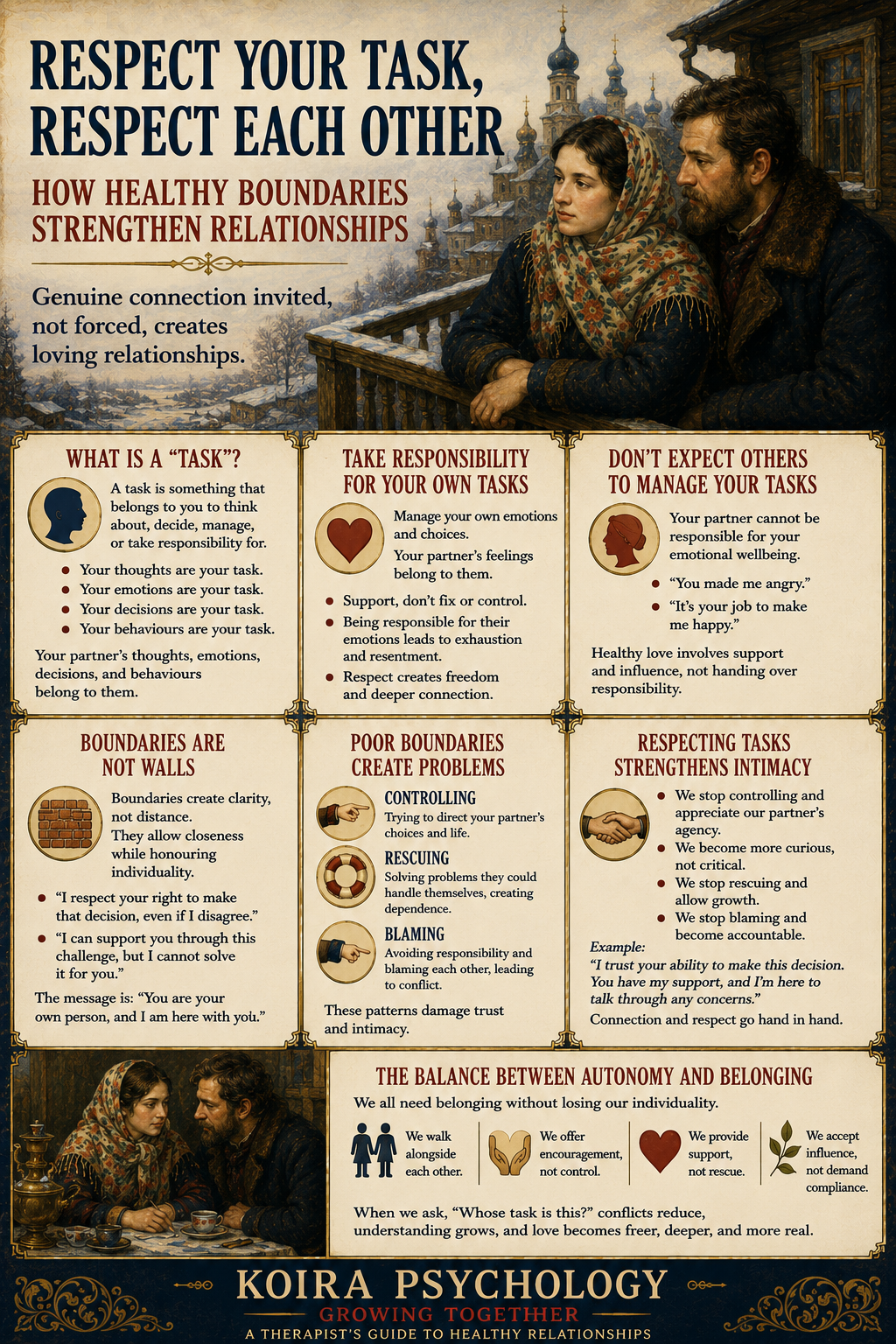
As a relationship psychologist, I often work with couples who feel exhausted by recurring conflicts. One partner feels controlled, while the other feels ignored. One feels responsible for keeping the relationship together, while the other feels constantly criticized. Beneath many of these struggles lies a common problem: partners become confused about which responsibilities belong to them and which belong to their partner.
The psychologist Alfred Adler, and later Adlerian practitioners, offered a helpful perspective through the concept of life tasks and personal responsibility. Adler believed that healthy relationships require both connection and respect for individual autonomy. In practical terms, this means learning to distinguish between our tasks and someone else's tasks.
When couples struggle to make this distinction, boundaries become blurred, resentment grows, and genuine intimacy often suffers.
What Is a "Task"?
A task is something that belongs to a particular person to think about, decide, manage, or take responsibility for.
For example:
● Your thoughts are your task.
● Your emotions are your task.
● Your decisions are your task.
● Your behaviours are your task.
Similarly, your partner's thoughts, emotions, decisions, and behaviours belong to them.
This may sound simple, but many relationship difficulties arise when partners attempt to take over each other's tasks.
When We Take Responsibility for Our Partner's Tasks
One of the most common patterns I see in couples is a partner attempting to manage another person's emotions.
For example, imagine a husband comes home looking upset.
His wife immediately begins worrying: My husband is feeling upset and I cannot bear unhappiness within him so I need to make him feel better
She asks repeatedly what is wrong, offers solutions, and becomes anxious if he remains quiet.
Although her intentions are caring, she has unintentionally taken responsibility for his emotional state, leaving her feeling exhausted, underappreciated, and dismissed.
His feelings belong to him. Her role is to be supportive and available, not to fix, control, manage or eliminate his emotions.
When we assume responsibility for another person's emotional experience, we often become exhausted and frustrated because we are trying to manage something that ultimately is not ours to control.
When We Expect Others to Take Responsibility for Our Task
The opposite problem occurs when we expect our partner to manage our emotional wellbeing.
For example:
"I wouldn't be angry if you didn't make me angry."
Or:
"It's your job to make me happy."
These statements place responsibility for our emotional experience entirely on another person.
Healthy relationships involve support, care, and influence, but they do not involve handing over responsibility for our emotional lives.
Our partner can contribute to our happiness, but they cannot be responsible for creating it.
Boundaries Are Not Walls
Separating tasks means having healthy boundaries. Many people misunderstand boundaries as creating distance or emotional separation.
From an Adlerian perspective, healthy boundaries actually support connection.
Boundaries allow two people to remain emotionally close without becoming emotionally fused.
A healthy boundary sounds like:
"I respect your right to make that decision, even if I disagree."
Or:
"I can support you through this challenge, but I cannot solve it for you."
These responses communicate both care and respect.
The message is:
"I am connected to you, and I recognise that you are your own person."
How Poor Boundaries Create Relationship Problems
When partners consistently cross into each other's tasks, several unhealthy patterns often emerge.
Controlling
One partner attempts to direct the other's choices, friendships, hobbies, career decisions, or personal growth.
For example:
"You shouldn't spend your time doing that hobby. It's a waste of time."
Rather than respecting the partner's autonomy, one person assumes ownership of decisions that belong to the other.
Rescuing
One partner repeatedly solves problems the other could handle themselves.
Over time, this can unintentionally undermine confidence and create dependency.
Blaming
Partners may avoid responsibility for their own feelings and behaviours by placing responsibility entirely on each other.
This often creates defensiveness and escalating conflict.
How Respecting Tasks Strengthens Intimacy
One of the surprising benefits of Adler's approach is that healthy boundaries often increase closeness rather than decrease it.
When partners stop trying to control one another, they become more appreciative of their partners’ agency.
When partners can appreciate each other, they become more curious.
When they stop rescuing, they allow each other to grow.
When they stop blaming, they become more accountable.
For example, imagine a wife is considering a career change.
Her husband might say:
"I trust your ability to make this decision. You have my support and I'm happy to talk it through any concerns you may have about making the change"
Notice the difference.
He remains engaged and caring, and he does not take over the decision-making process.
This creates both connection and respect.
The Balance Between Autonomy and Belonging
Adler believed that human beings have a deep need for belonging, but belonging does not require surrendering our individuality.
Healthy relationships involve two people walking alongside one another rather than carrying each other.
They offer encouragement rather than control.
They provide support rather than rescue.
They accept influence without demanding compliance.
When couples learn to ask, "Whose task is this?" they often experience a profound shift. Conflicts become less about controlling one another and more about understanding one another. Partners become less defensive because they no longer feel managed or judged.
Perhaps most importantly, they discover that genuine intimacy is not built through control or dependency. It is built through mutual respect, shared responsibility, and the freedom to be fully ourselves while remaining deeply connected to the people we love.
Why So Many Relationship Conflicts Become Personal

Key Points
Healthy relationships require clear boundaries around responsibility.
Adler's concept of "tasks" reminds us that each person is responsible for their own thoughts, emotions, decisions, and behaviours.Taking responsibility for a partner's emotions often leads to exhaustion and resentment.
Supporting a partner is important, but trying to manage, fix, or control their emotional experience can create unhealthy dynamics.Expecting a partner to manage our emotions undermines personal responsibility.
While partners influence one another, they cannot be solely responsible for our happiness, self-worth, or emotional wellbeing.Poor boundaries often show up as controlling, rescuing, or blaming behaviours.
These patterns can reduce autonomy, increase conflict, and prevent both partners from growing and taking responsibility for themselves.Respecting each other's autonomy strengthens intimacy.
Genuine closeness develops when partners offer support, encouragement, and understanding without trying to control or take over each other's lives.
Self-Reflection Questions
Do I sometimes take responsibility for my partner's emotions or problems in ways that leave me feeling exhausted or resentful?
Are there areas of my life where I expect my partner to be responsible for my happiness, confidence, or emotional wellbeing?
When my partner makes decisions I disagree with, do I respond with support and curiosity, or with control and pressure?
What might improve in our relationship if we focused more on supporting each other rather than fixing, rescuing, or managing each other?
-
Add a short summary or a list of helpful resources here.